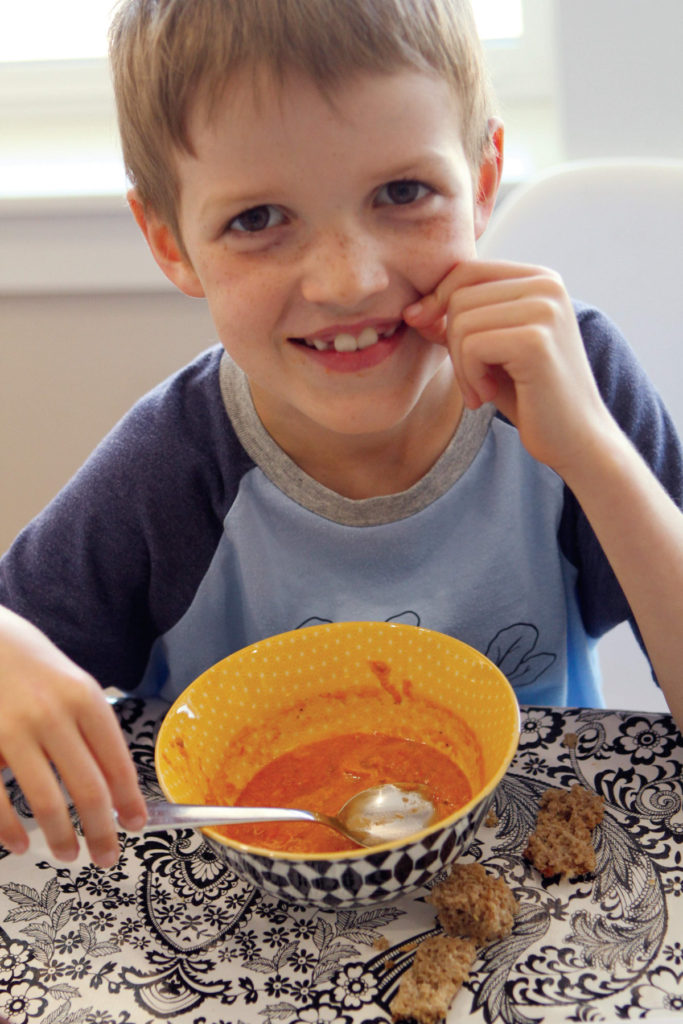
Vegan means your diet is free of animal products, including honey. Fruit by the Foot and Cracker Jacks are vegan, so it’s not necessarily a health move.
Plant-based means you focus on eating plants as opposed to meat and dairy, but you typically wouldn’t be scouring ingredient labels to check for a small bit of animal product. A Beyond Beef Burger on a white bun is plant-based.
Whole Food Plant-Based means you are focused on eating plants in their whole form, rather than processed foods like oil, meat substitutes, donuts, etc.
Our family aims for 90% whole food plant-based diet.
It turns out for the vast majority of us, protein is a non-issue. There is some protein in practically every whole plant food. I’m pretty sure all the hype around protein comes from the meat industry because it’s one of meat’s few redeeming qualities.
I’ve never in my life met someone who is protein-deficient, yet I know loads of people who are suffering from diseases caused by not eating enough plants and those people are still pre-occupied with protein. Go figure.
Not even a little bit. We decided to go 90% whole plant-based, thinking we wouldn’t want to give up cheesecake and bacon forever. Well, 12 years into this I have zero desire to eat bacon because my tastes have changed. If I really want something with animal products in it, like a gooey traditional chocolate chip cookie, I just eat it and enjoy it.
Nothing too exciting to report! I don’t have any other reference point, and they were all a bit different from each other. I get sick in the first half and want nothing to do with leafy greens, so that’s a bit tough. I don’t eat as well as when I’m not pregnant, but I’m still able to find foods that appeal, and I gained an appropriate amount of weight (~25-30lb) by just following my hunger cues.
Finding healthy hospital food is sadly a bit difficult, but I get creative and appreciate the food my husband brings from home even more.
Yep, this is a real question. All baby mammals need milk from their own species to thrive. I was grateful to be able to breastfeed each of my babies for over a year.
No milk. Once they’re done nursing, we just give them what we drink: water and occasionally smoothies. They don’t have a biological need for milk past a certain point, and certainly not from another species. Plant-based “milk” isn’t milk at all, so it’s also not a necessary part of a diet.
We use soy milk or almond milk in baking or on granola, but we don’t drink it by the glassful.
It doesn’t, except in one way: I pay attention to higher-calorie foods like seeds, nuts, grains, and avocado, and I make sure my kids get more of them. They get nut butter on their toast, but I’ll pass on that sometimes. I’ll serve their burrito in a whole grain tortilla with some leafies inside. I’ll often serve mine just on a bed of greens.
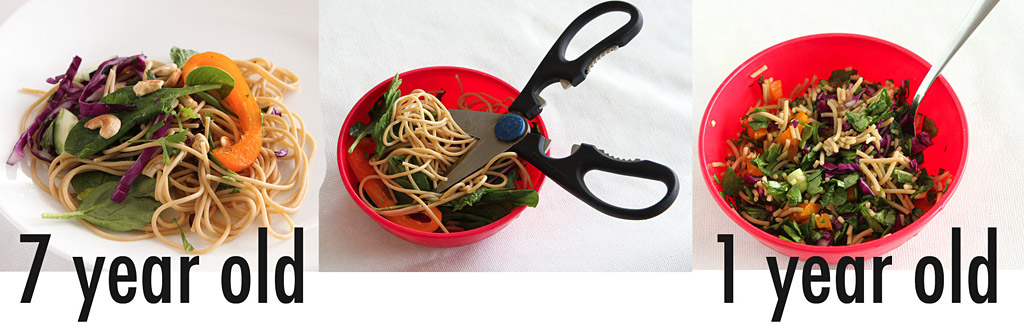
I also snip up my young kids’ salads so they can eat them more easily.
That’s it! As long as we’re not counting my mid-afternoon dark chocolate habit. My kids don’t usually share in that either.
The diapers. It’s wonderful my kids never have been constipated, and we’ve only very rarely dealt with diarrhea, but plant-based kids create a LOT of messy diapers. Lots of fiber and lots of nutrition means lots of diaper changes.
Yep. We have one who despises the texture of oatmeal made with rolled oats, another who doesn’t love raisins, one who turns up her noses at mushrooms, and another who avoids potatoes if possible. But they all love arugula, willingly snack on green beans, and load up on almost everything I cook. So they have food preferences, but we soldier on and we’ve seen many of those preferences shift over time.
Hardly ever. We do eat tofu a few times a month, and we’ve tried vegan cheese once. Pretty much the only meat imitation product we buy is the occasional Field Roast Sausage (so delicious but lots of added oil) and Beyond Beef Burgers (ditto.)
Scott loves a fancy restaurant meal periodically, and though we often seek out an ethnic restaurant that has vegan options, he has no problem with indulging in less healthy food on occasion. We believe it’s what you eat most that counts the most.
We teach our kids that it’s most important to be polite and gracious, but beyond a polite bite they aren’t obligated to eat something. Given the opportunity, we do let people know we’re vegetarian (most people don’t know what to do with vegans.) But we’ve been served shredded chicken and cheese enchiladas, roasted chicken, and more in people’s homes and we just eat some politely and fill up on sides. Relationships and health are our two priorities, but health won’t be ruined over one meal. A relationship might be if we don’t respond with tact.
Not usually. We believe the biggest improvement in health comes from eating whole plant foods, even grown conventionally, so that’s what we focus on. We do often buy in season and local, but we don’t focus much on whether something is certified organic.
Ok, your turn! Drop your burning question in the comments and I’ll answer it here.
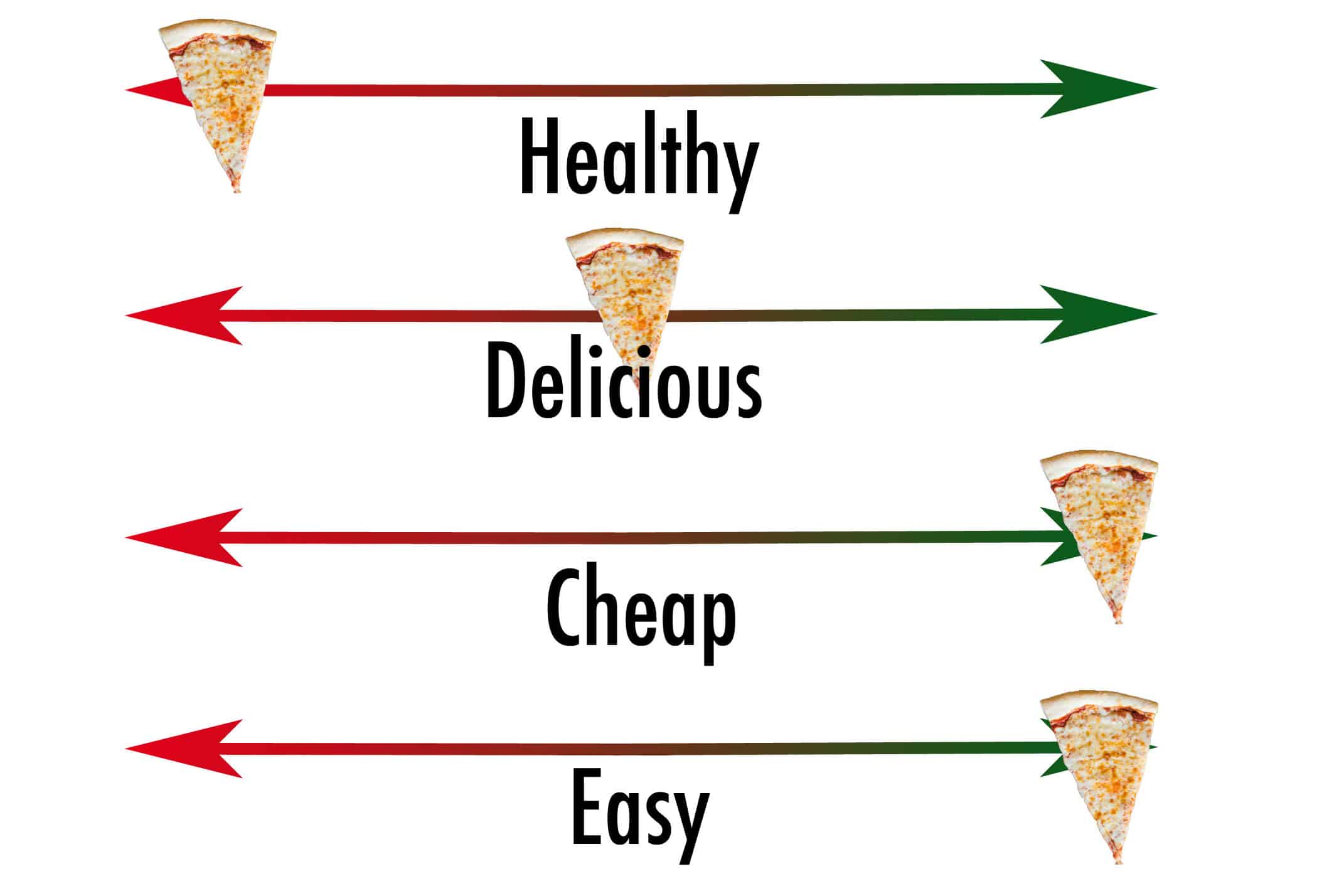
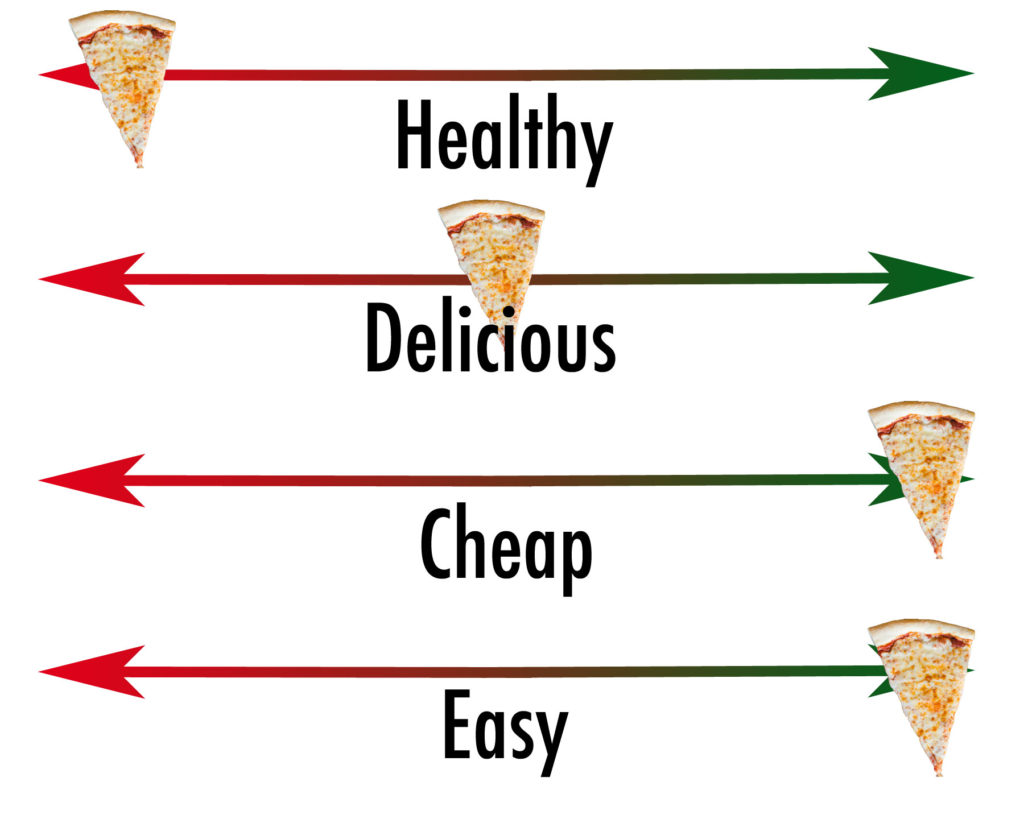
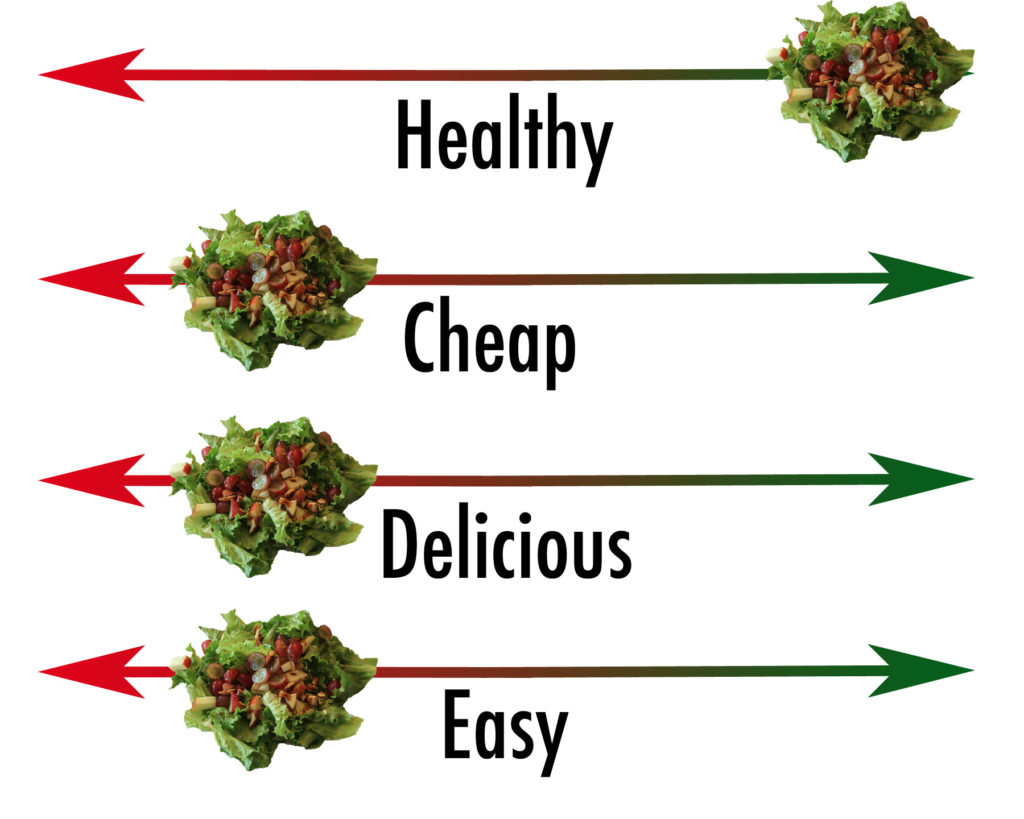
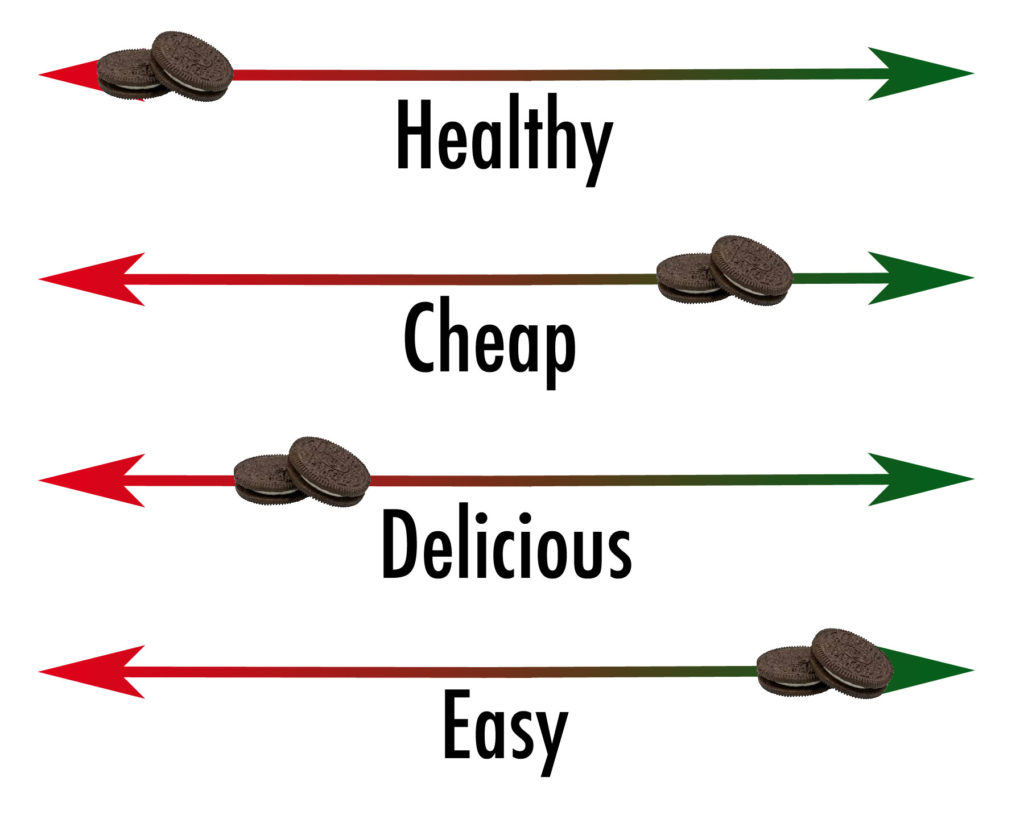
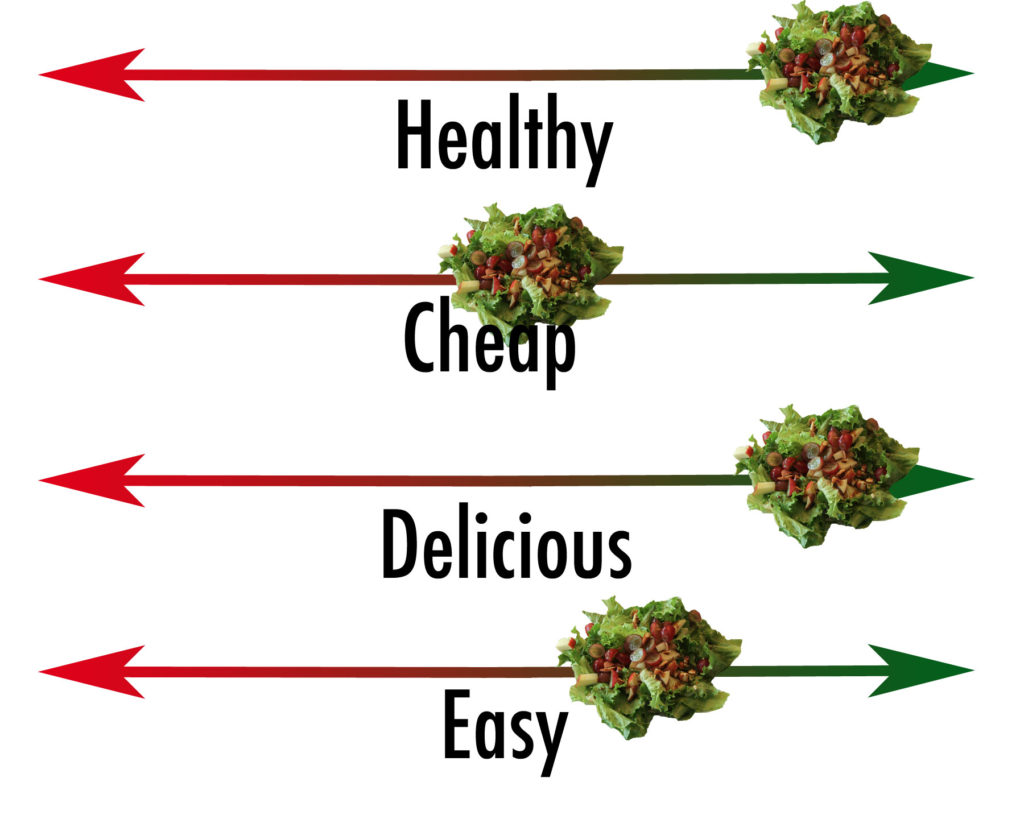
I discovered this magical way of viewing food in college, when money was scarce, free food was plentiful and greasy, and I found myself gaining weight and feeling kind of icky often.
Ever since, I’ve viewed food on the four spectra of:
cheap, easy, healthy, and delicious.
Here is where that free pizza they were handing out on campus fell:
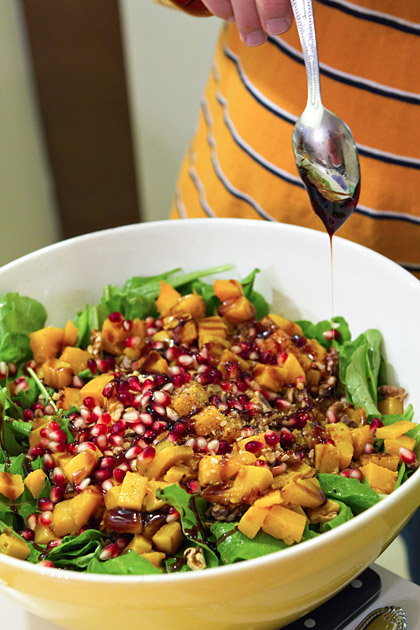
Whereas the image I had in my mind as synonymous with “healthy,” which was a big green salad, was here on the spectra:
Is it any wonder I accepted the free mediocre pizza and wrote “healthy” off my list of possibilities? I didn’t like vegetables, and the siren call of “cheap” and “easy” was compelling.
What’s currently driving how you eat?
Defining Terms
It turns out that every one of these metrics, with the exception of “healthy,” is highly personal.
All the science I’ve seen points to a whole food plant-based diet as being the Healthiest. It reverses and prevents many chronic diseases, promotes a healthy weight, and helps people feel their best.
But are whole plant foods Delicious? That, it turns out is a matter of opinion. I was a veggie-hater my whole life until I made the switch to a plant-based diet. My tastes have changed and I now eat hundreds of dishes I would definitely call delicious! What I’ve found is that while some plant-based foods are more universally delicious, like a freshly picked strawberry, others are only delicious if the rest of your diet isn’t full of processed food. Broccoli has its own appeal, but will lose to Cheetos because Cheetos don’t fight fair.
What does Easy mean? For some people it means essentially instant. If they can buy the food already made, that’s easy. Spending time in the kitchen chopping stuff definitely means that particular food is noteasy. Leftovers are easyand that’s one reason we love them around here. Of course there’s a continuum.
We often think in terms of whether obtaining and preparing the food is Easy, and neglect whether the food makes our life overall easier. 100 million Americans have Diabetes or Pre-Diabetes. I think chopping stuff up for a salad is overall easier than living with diabetes. Just sayin’. My husband tells me there were a lot of things that were hard about being 100 pounds overweight that he didn’t fully realize until he slimmed down.
How about Cheap? This, again, is highly personal and dependent on your immediate situation. For someone who is used to eating out, making their own meals is automatically cheap. For someone who is used to ramen, fresh spinach is going to come with a sticker shock.
One thing we rarely consider is how expensive it is to be in poor health. Everything from life-long medication for blood pressure to sick days taken from catching yet another cold take their toll, and anyone facing heart surgery would tell you that it’s far cheaper to fight heart disease with kale than it is with an operation.
How I Make Food Decisions
We try to eat a 90% whole food plant-based diet. That means aside from an occasional indulgence, I make Healthy my first decision criteria.
When I first made that change 10 years ago, it limited my options dramatically. I didn’t want to eat anything that wasn’t at least somewhat delicious, and I didn’t know how to cook with vegetables, thereby causing many things to be hard. Oh, and did I mention my husband was in medical school and we were going to have our first baby? Cheap was highly important as well.
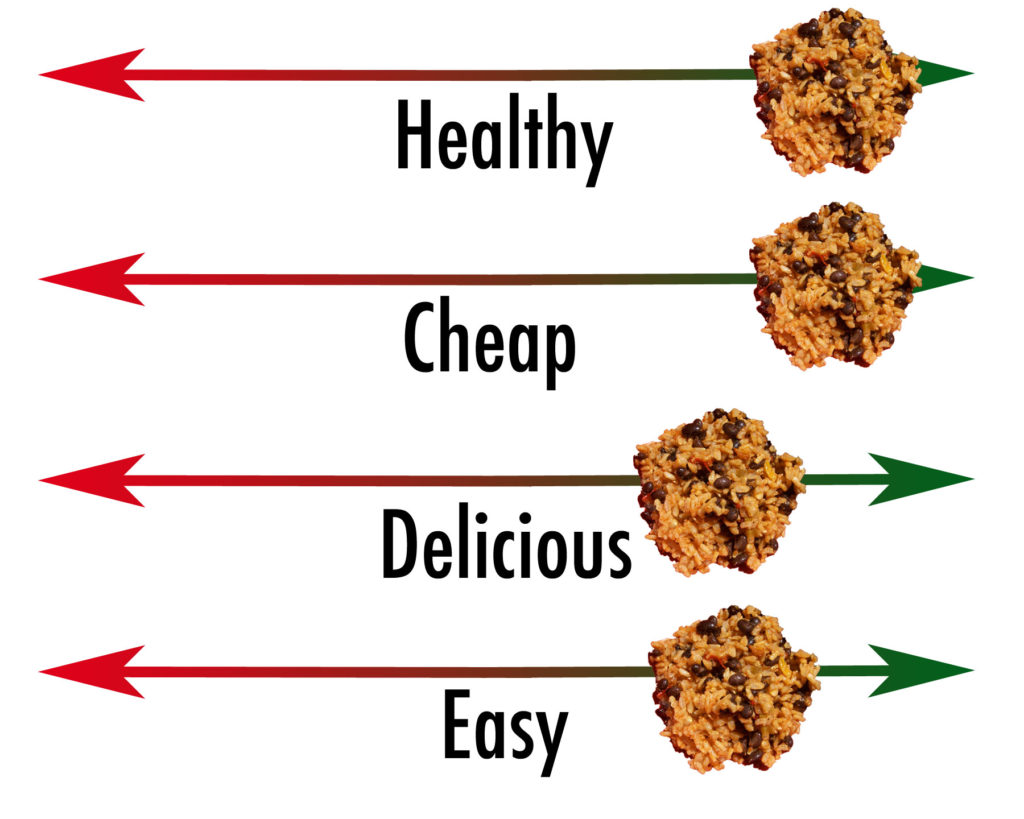
Thank goodness for beans and rice.
(As my tastes changed and I learned how to cook better, those beans and rice got more delicious and even easier. )
Apples we could go pick ourselves? You guessed it. Healthy, cheap, easy and delicious.
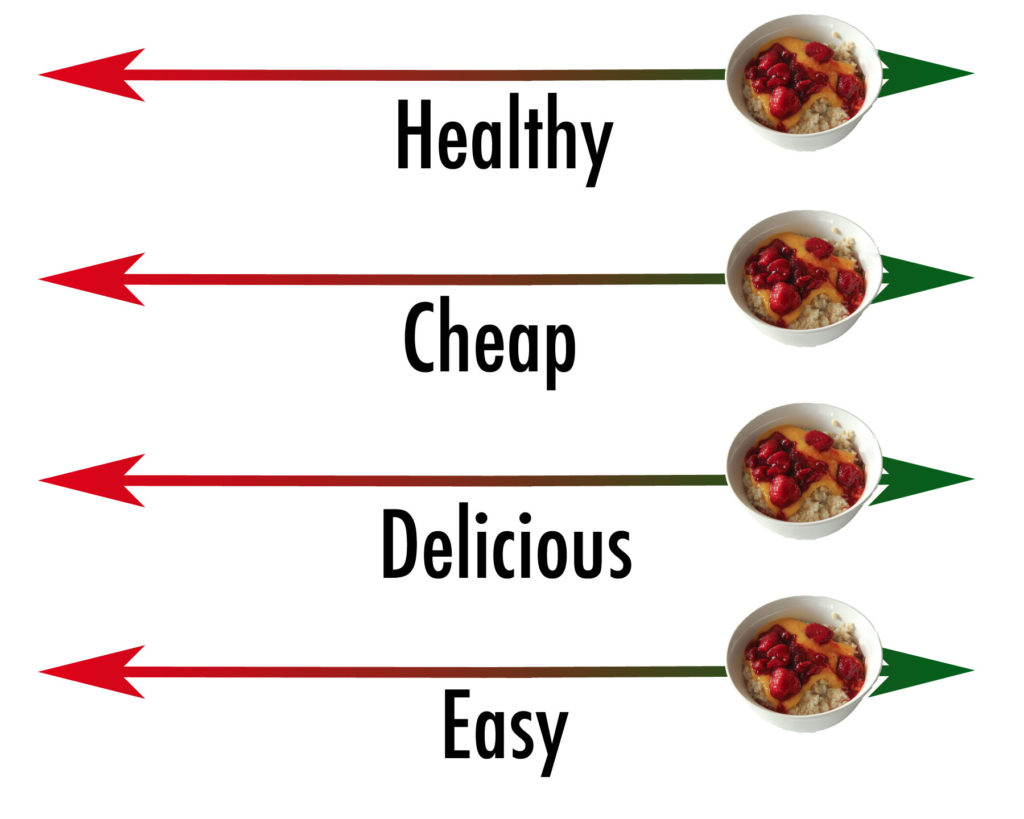
Oatmeal? Healthy and cheap. Once we learned how much yummier steel-cut oats were and all the great stuff we could add to them? More and more delicious. We figured out where to buy steel-cut oats inexpensively in bulk and how to cook them without spending time standing at the stove. Now they tick all the boxes.
See how magical this is? Now when I encounter a new recipe (or a subpar store-bought cookie at an event), I can quickly evaluate whether I want it in my life.
As you may have guessed, I give more weight to “Healthy” than the other categories. “Cheap” is rated less now that I have more wiggle room in my budget. “Easy” is more important now that I have 5 children I’m homeschooling.
Simpler Food Decisions
Difficult recipe? It had better be out-of-this-world delicious or it’s a definite NO.
Healthy but contains beets (ie not delicious)? NO. There are plenty of yummy healthy foods. I can pass on things I just don’t like.
Delicious recipe but not healthy? Usually a NO from me because delicious food is only briefly enjoyed whereas the effects of fueling your body well endure. Besides, I’ve been eating this way long enough I have dozens of options that are both delicious AND healthy. It’s not either/or. It’s both!
Delicious and healthy? YES, please.In my experience, if I find something that is both delicious and healthy, there are lots of ways to get it cheaper or easier.
Put it on The Food Spectra
If you’re new to the idea of plant-based eating, hang in there. Stick to your goals and keep finding those things that are healthy AND fit the other criteria that are most important to you.
With some time and practice, it will become easier and your tastes will change so that the big bowl of salad is actually delicious. Trust me, I’ve changed from being a veggie hater to a veggie lover!
Take it from this mother of 5 plant-powered kids: You can absolutely help your kids (and spouse!) enjoy a more plant-based lifestyle.
You’ve done your research and you’re convinced that a vegan, or plant-based, diet is better for your family’s health. Or maybe you’ve recently watched a compelling documentary and you’re curious enough to give plant-based eating a try.
It’s intimidating though, because serving up three meals a day to a hungry family is no joke. You might have kids who turn their noses up at new foods. You may have a meat-loving spouse, and perhaps you yourself don’t even like vegetables
I’ve Been There.
When I switched to a plant-based diet over a decade ago, I only like baby carrots and corn on the cob. Really and truly. Salad was definitely a no-go. What’s more, my husband considered himself a “meat and potatoes” man, and I didn’t exactly have a lot of skill in the kitchen.
Finding your groove will take some time, but with persistence, you’ll get to a point where it feels far more comfortable to throw together a plant-based meal than to go back to your old stand-bys.
Of course, just getting healthy food on the table is no guarantee that your family will eat it! It’s no fun when you’ve put all the effort into making something for your family and it’s met with grumbling (or worse.)
Let me offer some hope on that front: Although my own kids have grown up eating this way, we regularly have other children come stay in our home for extended periods of time (through the Safe Families for Children program). I’ve seen these kids go from wanting Pepsi and Flaming Cheetos to asking for more snap peas for their snack in a surprisingly short time.
Preferences and attitudes often change quickly given the right environment.
A Few Small Truths:
Sweetness
Fruit is so much sweeter when you are not constantly eating food with added sugar in it!
Adaptation
Our taste buds are constantly changing, and with time everyone will find new (healthier) favorites they’ll think they can’t live without.
Attitude
Kids (and husbands) can learn not to grumble. With some new habits they’ll try new things with more gratitude. (Find help with table etiquette here.)
Hunger = Sauce
The absence of go-to filler snacks means we have a good appetite when meal time comes around, so everything tastes better. Hunger is the best sauce.
“As a mother, you are largely responsible for creating the food environment in your home.”
Anne Bean
Feed Them Plants
Here’s a perfect example: Every time I’m pregnant and morning sick, the whole family’s eating gets thrown for a bit of a loop. Why? Because I’m the one usually planning meals, stocking the fridge, officiating at the kitchen table, and setting an example. When I’m curled on the couch with a bowl, even though my husband picks up the slack when he can, everyone else is eating a lot more cold cereal. I’ll bet you can relate!
Mothers know better than anyone else that life has seasons, but setting a baseline of plant-based eating means that you have a good groove to settle back into when you come out of survival mode.
You can find loads of lists online with “quick tips” to get kids to eat more vegetables, but what I’d like to do is walk beside you as you change your family’s food culture.
Food is so emotional that there’s seldom a quick fix if you want lasting change. However, what we eat has such a big impact on our health (and weight, self-confidence, mood, and behavior) that it’s a tremendous opportunity to strengthen our family now and give our kids a solid foundation for the future.
Unfortunately, the prevailing food culture in our country is toxic right now. It’s literally making people sick and fat, dramatically decreasing our quality of life. If you were to simply follow the marketing, believe the billboards, and buy what you see lining the shelves at the grocery store, then you could only expect the results that others are getting: obesity, heart disease, diabetes, and cancer. If this paragraph sounds overly dramatic, you should see the actual data.
The wonderful (and simultaneously tragic) news is that these things are optional. While we can’t change our country’s approach to eating overnight, I know that as a mom, you have tremendous power to heal your own family.
There’s a catch though. (You knew there would be!)
Change. Is. Hard.
It just is! There’s no avoiding it. And food is so wrapped up in our emotions, our traditions, our memories and relationships, that when you consider a change to what you eat you are doing something rather enormous.
But food is so powerful. Eating well gives you more energy to pursue your life’s purpose. When you eat well, you give yourself: better sleep, more stable emotions, a healthy body weight, a longer life… the list goes on. Your good health puts you in a better position to help those you love, and your example will light the way for others. Truly the two most precious things we have in this life are relationships and our health, and putting more plants in your body can improve both!
So this is going to be hard, but it’s the good kind of hard. The satisfying, proud-of-yourself, invest-in-the-future-of-those-you-love kind of hard.
And I feel like I need to tell you right now:
You can eat as much as you want of delicious whole plant foods. No counting calories or finishing before you’re full. This is what I regularly order at Chipotle:
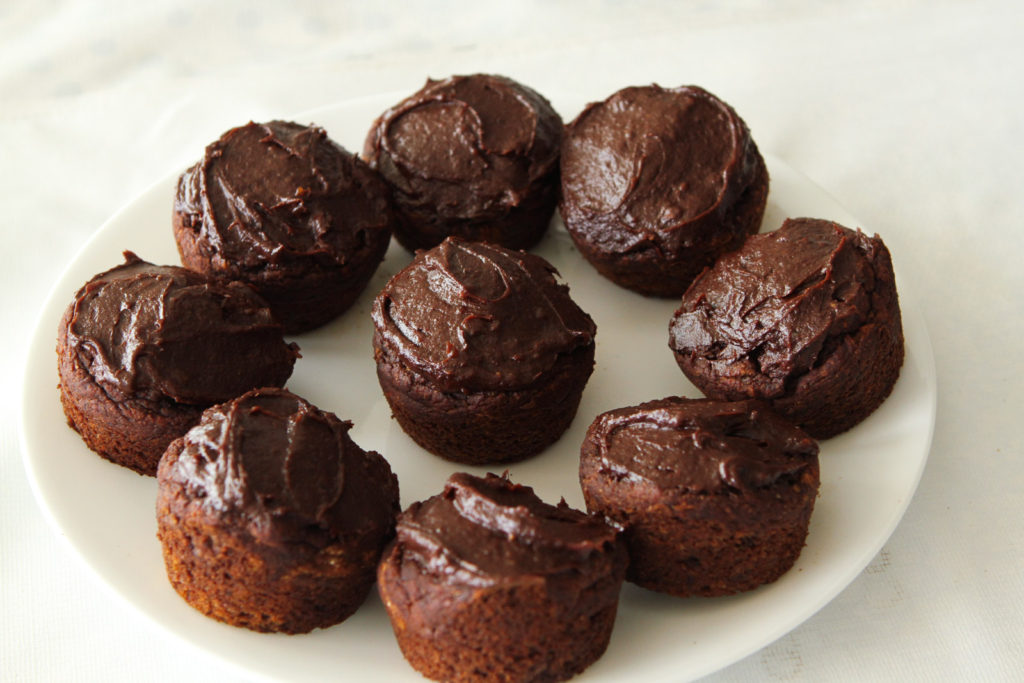
Also? You can totally still have chocolate cupcakes. These are made of whole plants, and they are decadent and delicious:
And no, there are no black beans hidden in there, though that is a thing. We prefer those in burritos.
Know your starting point
I strongly recommend taking the time to assess what things are like currently in your family with regards to food. It’s worth writing down, even, both because you can leverage your current habits and strengths to make the transition easier on yourself, and especially because you can better see how far you’ve come if you have a clear “Before” picture in mind.
Take an inventory of what a typical day or week currently and realistically looks like in terms of food and meals.
Where are you now?
Do you plan meals or wing it?
What happens for breakfast on school days? On the weekends?
How about lunches, dinners, snacks?
Are you eating out a lot or a little? Where and why?
How much time are you spending in the kitchen currently?
What role do fruits and vegetables play currently? Beans? Whole grains?
What do people in your family drink?
What cooking skills do you have, and are you willing to learn more?
Do you know what you typically spend on food? Do you try to stay on a tight budget or is there some flexibility?
Do you have any members of your family that you might describe as “picky?” (p.s. I recommend choosing different words for that, but here’s help for “picky” eaters.)
What diet-related health concerns do you currently have for yourself or family members
Here’s an example of what you might come up with:
I’ve never quite gotten meal planning to work, so we usually end up at the grocery store several times a week picking up food for dinner. Breakfast is usually something cooked on the weekends (pancakes, eggs) and cold cereal or frozen waffles during the week. The kids are supposed to pack their own lunches, but they end up with a school lunch a few times a week. We go out to eat once a week as a family, order pizza in once a week, and pick up fast food through the drive-thru sometimes when we’re running between activities. I consider myself a good cook, but I tend to make the same dishes again and again. We eat a lot of chicken and cheese, because nobody complains when I serve those. My 6 year old thinks green things are “gross” and my husband can’t live without hamburgers. The pediatrician recently expressed concern about my daughter’s weight, and I’d like to lose about 15 pounds myself.
You get the idea!
Your situation may be completely different, and that’s why I recommend pausing to really consider it before forging ahead.
What’s the Ideal Diet?
Unfortunately, there is a lot of confusion in the popular press about what constitutes a healthy diet. So many trendy diets come and go (Atkins became paleo, which became keto! Macros! Whole 30! “Eating Clean” and countless more). Everybody loves controversy, so we click on articles that imply red meat is healthy after all, that coconut oil is the new miracle food, and that eggs aren’t as bad as we thought.
Money is the culprit. “New” diets sell books, “new” studies that seemingly contradict established truths garner clicks. If everyone just went ahead and ate vegetables there would be a lot less drama and disease in the world.
When you go to the science though, there’s very little controversy about the foundations of a healthy diet. The longest lived populations on earth eat mostly whole plants. Foods with fiber win! It’s surprisingly straightforward. The same foods prevent heart disease and type 2 diabetes as prevent obesity and dramatically reduce your risk of cancer. The more plants (vegetables, fruits, beans, whole grains) you eat and the less of anything else (meat, dairy, added sugar, oil, and processed grains) the better for your health.
The science is compelling, but almost more so for me are the real-life examples I see. I try to be a noticer of the long-term results of other people’s choices so I can more wisely choose for myself. I know plenty of people in their 30s who look trim and fit on a variety of diets. However, I know very, very few who look trim and fit into their 60s and 70s and are free of chronic illness. That is, outside the plant-based community. When you look at people who actually eat this way, it’s rare to see anyone overweight or with a chronic condition. And the longer they eat this way, the better they look and feel.
I’m always cautious when reading studies to keep in mind that “association does not prove causation,” meaning just because two things are often found together doesn’t mean one causes the other. However, in this case I’ve actually seen a diet change consistently cause a health change, so I feel pretty confident I know the long-term results of this effort. And I like them!
Here’s my mom at 68:
My kids love having an energetic grandpa who eats plants. My grandpa (his father) died of a heart attack when I was too young to remember him, so it’s extra significant for me that my dad’s arteries are clean and clear because of what he eats:
I wish we knew then what we know now. But, of course, knowing doesn’t actually help if we don’t change our actions to match.
How Did We Get to Where We Are?
If you are like the vast majority of people, your self-assessment revealed that your family eats quite a bit of processed food, meat and dairy. Fruits and vegetables play a minor role, and perhaps you’re not as deliberate about what you feed your family as you’d like to be.
Here are some reasons why, and they aren’t your fault:
We are constantly faced with a barrage of images and videos that imply our family will be happier if we feed them junk food!
Hamburger Helper will save our sanity. The kids will suddenly be polite enough to smile and say “Thank you” if you give them the new flavor of goldfish cracker. No one will squabble at the dinner table if Velveeta is on it.
If that sounds far fetched, look carefully at the next ad you see targeting you to buy food. I’ll bet it’s either a reward because “you deserve it” or an implication that food will somehow solve relational problems and stressors in your life. Of course we know that can’t be accurate, but the marketers continue to send those messages because it’s working! We’re buying the food with the happy kids in the commercials because we want our own kids to be happy. We want to feel like we have our act together, so we’re doing what the lady who seems to have her act together is doing.
But here’s the thing: broccoli doesn’t have a very big marketing budget. Blueberries or lentils aren’t going to buy their way on to our instagram feed very often. When food is processed, it’s more expensive to buy and cheaper to produce, which leaves enough profit to invest in more flavor engineering and plenty of very targeted marketing.
Processed Foods are Designed to be Hyper-Palatable
Even after we buy them, processed foods are tricking us into wanting more of them. Foods that occur in nature are flavorful and offer a variety of textures that we can appreciate. Foods produced in factories take everything to the extreme. They are so salty, so fatty and/or so sweet that they hijack our taste buds and leave us craving more of things that can never satisfy. That’s why it tough for a kid to appreciate a vegetable stir fry when he’s had Doritos for snack. Millions of dollars have been spent on the exact mouth feel and flavor of a Dorito chip. You’ve spent 15 minutes throwing the stir fry together. It’s tasty, full of color, and nutrition, and you want it to be well-received, but it’s an uphill battle for someone whose palate is accustomed to processed food.
And so, to keep the peace, to keep our sanity, we give our kids what they want. But we’ve created a situation that seems easier now but will assuredly be harder later.
But you’re flexible, you’re creative, and you’re powerful. You can effect change in your home.
Know Your Goal
What do you want for our family in terms of food? What do you want from yourself in terms of effort in this area? What kind of habits and attitudes and preferences do you want your kids to leave your house with? How about weight and health?
Here are some things that I could put on my goal list:
I want my family to enjoy preparing and eating food together.
I want to be wise in planning meals so that we don’t waste money on food we don’t eat, and I don’t spend more time in the kitchen than is necessary to achieve my other goals!
I want us all to be in tune with hunger cues so that we can feel satisfied and not eating in response to emotions.
I want eating whole plant foods to be the “regular” thing in our family, and deviations from this to be guilt-free.
I believe this will lead to family members maintaining an ideal weight and the best health possible.
While those are worthwhile goals, that’s far too much to remember!
Author Michael Pollan summed up an ideal diet much more succinctly:
“Eat food. Mostly plants. Not too much.”
– Michael Pollan
(He clarified that “food” meant real food, not processed with chemicals you can’t pronounce. )
His is a great statement! But, I haven’t found the “not too much” to be a necessary addition. It turns out you can eat lots of whole plants without weight gain, because they aren’t very calorically dense. It’s one of my favorite things about eating this way! No calorie counting or portion control. Here’s mine with adjustments:
“Eat real food. Mostly plants. Do it with love.”
-Anne Bean
My reason for feeding my body well is because I love it, and my reason for feeding my family is well is because I love them. So, that means one of my goals as a mother and a wife is:
“Feed them real food. Mostly plants. Do it with love.”
-Anne Bean
That was my goal when I changed my diet 13 years ago, and I think that’s why I’ve been able to stick with it ever since.
When we are motivated by love rather than by fear or guilt, the results will last far longer.
I started out convinced that this was the best way to treat my body, but without any skills in the kitchen, or any real fondness in my heart for vegetables. In fact, I would have sided with the six-year-old example up above in thinking them generally “gross.”
But I had a vision for what I wanted in my body and family future, and I knew it was dramatically different from where most Americans (and now people around the globe) are headed.
The CDC tells us that more than 70% of adults over age 20 are overweight or obese, and those are actually very conservative numbers because of the way BMI is calculated. With my build, I could carry an extra 30 pounds and still be considered “normal” weight. But I can tell you right now I would not feel as as good if I was carrying a toddler on my back 24/7! (Though it seems like some months that’s just what I’m doing… my toddlers always love their Mama.)
An insidious message in our culture has been to “love our body no matter the size or shape,” which then translates too often to indulging our body’s appetites. Of course love your body! It’s the only one we have, after all. But do treat it well because, it’s the only one you’ll have. If you feed it right, it will look its best.
Imagine a future when you’re sending your daughter off to college. “Normal” for her is showing love for her body by generally eating when she’s truly hungry and choosing plant-based, unprocessed food. That girl is going to be the one at the salad bar in the cafeteria, seeking out the lentil soup, stocking up on brown rice and bananas at the grocery store and calling you to share her delight that pomegranates are back in season. You’ll have set her up to avoid so many pitfalls in her future. And even if she turns to brownies to get through finals week on occasion, she will fall back on the habits of her childhood again and again. Because of your efforts now, she will have the skills to continue a healthier food culture and share it with others.
Of course we want this for our kids, but with anything, it has to start with us.
You First
Since becoming a mother, I’ve often seen myself reflected back in my children’s attitudes and behavior. This is so satisfying when I see my toddler sharing bites of her food with me or sweetly saying “tank oo” because she’s seen me do the same. It’s downright painful when I see my 9 year old respond snappily and I realize I’ve been short-tempered lately, and she’s just doing what she’s seen me do.
My husband is a family physician and often has parents come in concerned about their children’s weight. These are great parents who are anxious for their children to have a great start in life. My husband often gently asks them about their own weight and habits with food as a starting point to the conversation, knowing that where the parent isn’t willing to go first, their children have little opportunity to follow.
Related example: I homeschool and am often asked how people can encourage their children to be readers. The first piece of advice I give them is to read themselves, and read to their children. If they think they are too busy to read or don’t enjoy it, they have little hope of igniting a desire in their children to do so.
If I really want to keep snacking on yogurt covered pretzels all afternoon and nursing a diet Coke, but I want my kids to be eating broccoli and hummus, I’m in a bit of a pickle.
I want to be clear: I’m not saying you need to change your diet before you change your family’s diet. Instead, I recommend that you bring your whole family on board with healthier eating at the same time. Nobody wants to be fixing multiple meals all the time if they can help it!
Just make sure you are actually on board yourself – willing to give it a good try. Kids can sniff out hypocrisy! Plus, they will unconsciously mirror what you are doing so your modeling is key. If this is just about “fixing” them, be prepared for some self-examination.
Parenting, right?
You Are the Boss of Your Family
And feel free to tell your kids I said so, if things get rough when the junk food starts disappearing at your house. You are the boss.
Seriously though, the person who is willing to buy and cook the food for the family is the one who directs what the family eats.
People are lazy by nature, and very few will object so much to a diet change that they will put for the effort to cook something different. That works in your favor here.
My husband has patients come into his practice and wring their hands that chicken nuggets are the only thing their child will eat. Kids with strong food preferences can definitely be concerning. (Here’s help for “picky” eaters.) But, as my husband tells the parent, keeping a very sympathetic tone (parenting is hard!), “If you don’t give them chicken nuggets, they won’t eat them. Promise.”
It really can be as simple as that! I’m saying simple here, not necessarily easy.
If your kids were whining to watch a tv show you thought was inappropriate for them, or if they wanted to stay up all night because they thought bedtime was torture, you likely wouldn’t say, “Well, you know what you like. Go ahead.” Parenting involves helping them learn how to make good decisions, and guiding those decisions (strongly!) when they are young. But when it comes to food, somehow we are afraid of setting limits.
Change is hard and there may be some whining and complaining for a time, but at the end of the day, the only way your kids are going to eat eat junk (generally speaking) is if you buy it for them!
If you start handling food and meals differently, the whole family will start eating differently. Behold the power of a deliberate mother.
Your Next Move: Go All In Or Make One Change at a Time?
Back in 2006, my husband and I decided to go 100% plant-based for six weeks as a trial. We knew the science was sound, but we wondered if we could possibly make it work. My husband worried he’d always be hungry and miss his meat. As for myself, I may have mentioned vegetables were high on my “Foods to Avoid” list. So, we agreed to give a good try and then re-evaluate.
We ate a lot of black beans at first, because we liked them and could change them up for different simple meals (bowls, burritos, soups, cheeseless nachos). We got better at it as we went, and we were surprised how quickly our tastes changed and how much better we felt. We were sleeping better, had plenty of energy, never had that post-meal comatose feeling, and we enjoyed eating until we were full. Our grocery budget went down, and the decision was easy: We didn’t want to go back to our old way of eating.
My husband had previously lost over 100 pounds (mostly through calorie restriction,) and we knew that a plant-based diet would be key in helping him maintain that. He was happy to have so much variety and flavor without having to limit portion size.
Doesn’t he look great, especially for having been a 280 lb teenager? (I’ll post his recommendations of how to help an overweight kiddo soon!)
But wait, you say, “Is that a legit eclair you’re eating on the streets of Paris? I thought this was supposed to be a lifestyle change!”
Yes, yes it is. But also notice in the picture the tub of hummus we picked up to take home to dunk our veggies in for lunch. We decided all those years ago to shoot for 90% plant-based, to allow for occasional dairy-based desserts, flavorful cheeses, or other favorites we didn’t want to write off entirely. We’ve stuck with this for more than a decade because it was flexible enough so we don’t feel ever deprived, but also it was a significant enough deviation from our old pattern of eating that we’ve found new favorites, that we enjoy 90% of the benefits of a plant-based diet, and we’ve truly changed the food culture in our home.
For us, going all-in on changing our diet (but only settling in at 90%) was a good choice. It forced us out of our comfort zone and we learned to swim much more quickly by jumping in the deep end.
Benefits to Going All-In
See the benefits very quickly
If you are someone who is curious if this diet will improve your health and/or weight (spoiler alert: it almost certainly will), if you go all-in, you’ll be able to see and feel the benefits within days and certainly weeks. If you just stick your toe in the water by adding a few meatless meals every week, your health is unlikely to change enough (or quickly enough) to reinforce the eating changes.
There is power in a “bright line”
Some people do much better with a clear boundary, and if you set a timeline and agree in advance to just eat plants for that amount of time, you free yourself from the wrestle of indecision and self-control for every meal and snack.
You’ll learn more quickly
It’s plants or nothing with this approach, so you’ll figure out much more quickly which plants you already like, and you’ll be more apt to try new ones. Some people describe it as learning how to grocery shop and cook all over again, but you can at least shorten the learning time!
This can be a family adventure
It might be easier to get buy-in from a spouse or teenagers if you pitch it as a trial period, or a challenge. “From now on” is scary. “Let’s try something cool for six weeks” is intriguing.
Challenges of Going All-IN
There is a potential for “easy come, easy go.”
If you have experienced boom and bust cycles with behavior in the past (and who among us hasn’t?) you know that starting something too hastily without really buying into it can lead to abandoning it just as quickly.
Creating lasting but more moderate change in your family is going to have a more positive impact on long-term health than a very short-term turnaround.
It requires more of you
If your diet is pretty standard for an affluent country, you’ll be making a lot of changes all at once to go fully plant-based. Our lives have seasons, and to set yourself up for success, make sure you have the extra “umph” to make the change before you jump all in.
(Remember how before potty training, you have to take a deep breath and gather your strength before embarking on a potty training adventure? You’ll want to pick a time when you can commit the extra effort to focus on this. I promise it’s more fun than underwear accidents though. )
You’ll also need a clear vision of where you’re headed to help you stick with it for the whole trial. Then really be aware and recognize the improvement in how you feel in order to sustain the change going onward.
The Other Option: Pick One Place to Start, and Keep going
Look at your family’s current eating, and pick one place to target. Soda? Candy? Fast food? Pop-Tarts for breakfast? Identify one area and get to work. (Here’s why I think you should eat oatmeal for breakfast if at all possible.) Remember that any step in the right direction counts for something, and it can build momentum to keep going.
Just make sure that you do keep going, because one meatless dinner a week is not going to give you the vibrant health you’re looking for. If you put in 10% of the effort, you’ll get 10% of the results. Remember that your diet will need to be significantly different from most Americans if you want to have significantly improved health.
Benefits to Slow and Steady Changes
You may get less pushback from family members
If all the favorite foods don’t disappear at once, the change may feel less threatening. You might be able to wrap new foods into your routine without raising too many red flags and quietly not re-buy others when you run out.
This benefit younger kids and spouses who aren’t food-focused. I would guess most older kids will figure it out pretty quickly, and you’ll need to either get them on board or be willing to carry on with some resistance!
You’ll be able to target and replace individual habits
Habit change tends to be more sustainable when addressed at the micro level. Switching from chicken soup to lentil soup for dinner is wonderful, but if you’ve also got a mid-morning cookie snack, a weekly donut run, and after school fast food tradition to tackle, then it may that if you go with an all-in challenge, you’d slide back into your same habits once the shine wears off.
If instead, you start by tackling the cookie snack and replace it with fruit, then come up with a new after-school tradition, etc. you might shift your baseline slowly but surely, with less friction.
Challenges of Slow and Steady Changes
You may actually get more pushback from family members
It could be, depending on the personalities and dynamic in your family that each individual change is resisted, so you are fighting lots of extra battles by making changes over time.
Tastebuds won’t change as much with small changes in diet
Broccoli just won’t taste very good until graham crackers are off the menu. Consistently feeding kids easy-to-like processed food cripples them when it comes to embracing vegetables. (And it does the same to us adults!) Added sugar throughout the day makes kale taste bitter. If it tastes bad, nobody will want to eat it for long, no matter how healthy it is.
People are constantly marveling that my kids will voluntarily chow down on green beans, a heart of romaine, or a bowlful of frozen veggies. But there would be little chance of them doing that if there were ritz crackers and fruit-by-the-foot in the pantry.
If you’re trying to simply add the good stuff without getting rid of the bad, it’ll be tricky with kids. (For adults, filling your plate with good stuff often can crowd out the bad more naturally, but kids resist the flavor of vegetables far more in my experience.)
Strike while the iron is hot?
If you’re fired up and interested in a plant-based diet, taking baby steps to get there may just take the wind out of your sails. Consider forging ahead and getting your feet wet. Ride the momentum of your initial motivation.
Take Heart
Go ahead and consider the approaches and decide which one is the best fit for your personality and circumstance.
However you begin, though, take heart. You don’t have to be perfect at this to help your family improve their health. It gets easier with practice, and it’s becoming popular enough that there is a lot of support from those who have walked this road before. Stick with it and you’ll see a healthier baseline emerge for you and your family.
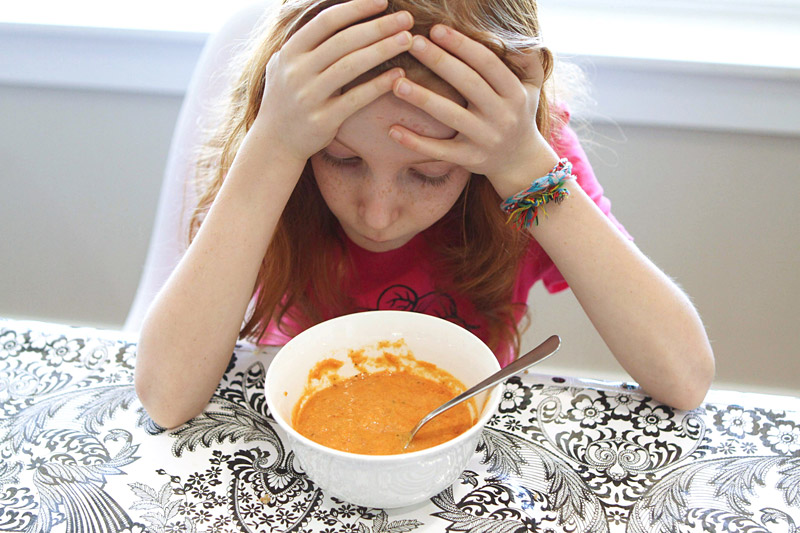
There’s the baby who screams and knocks the bowl of squash on the floor because she wanted bananas. There’s the toddler who won’t eat her beans because they’re touching her rice. There’s the grade schooler who really despises the sight and smell of broccoli and grills you to see if there’s any of it hiding in whatever dish you made. There’s the husband who wants his food spicier or (ack!) smothered with cheese. There’s even me, a fully grown woman who still doesn’t like beets after trying them dozens of times.
There’s something inherently exhausting about planning and preparing a plant-based meal and then presenting it to a crowd who doesn’t seem to appreciate it at all.
So what’s a mom to do? Of course we know that a child often needs to try something many times before they learn to like it, but what does that process look like at a real family’s table? And what happens if they refuse to try it? Or they have tried it and still don’t like it? (Me and beets!)
I have five children with a variety of food preferences and a foodie husband; we’ve been eating plant-based for over a decade. Here’s what I’ve learned to help picky eaters.
Principle #1: They’re Not Picky
We avoid the word “picky” around here when describing people. I use it in this article because it’s a popular term, but I think it pigeon-holes people into living up to the label.
I don’t refer to my kids as “picky.” Instead, I might say, “Potatoes aren’t your favorite, yet. Who knows, though? You might like them in this soup.”
“I know you prefer your tomatoes blended up, but they’re chunkier in this sauce.”
“My husband’s favorite foods tend to be ones with lots of spice and flavor.”
It’s totally cool to have food preferences. But being known as “picky” creates unnecessary tension.
In our home, we teach our children from a very young age to only say positive things about the meal (and our efforts to prepare and present it), unless they are specifically asked for their feedback.
It is basic etiquette to compliment and/or express appreciation at the beginning of the meal. Even if you’re served something you find disgusting, you can thank the person for making it. My experience is that when you teach this at a neutral time (not when you’re frustrated because they turned up their nose at what you just served them), kids are happy to learn how to be polite.
It can be a game to find ways to compliment something they think they may not like. “It smells exciting!” “Thanks for making this, Mom. I’ve never had pasta like this before,” they may say as you pretend you served them shoelaces with spaghetti sauce.
At the dinner table, I can often tell how everyone likes the food just by watching how they eat it. But if I’m looking for more feedback, I may ask, “What do you think of this new pasta sauce?” My kids know they can answer “It’s not my favorite.” We practice that exact response a lot when they’re young, and it pays dividends for years to come. I may press them for details, and they can say they wish it didn’t have mushrooms in it, or they wish it wasn’t so salty or chunky.
Because they are withholding any critical comments until pressed, it does a few foundational things for our shared meal experience:
They aren’t voicing (and therefore reinforcing) a negative first impression. If they loudly proclaim they hate something, it will be that much harder for them to admit even to themselves that they like it later on!
It is infinitely nicer to serve something to a chorus of polite comments, even if some of them seem a little creative. 🙂
Note: This also applies to adults. That means my husband models this even when he doesn’t love what I cook, and it means when he prepares the meal I’m all (sincere) compliments and appreciation unless he specifically wants to know how I like what he made.
Principle #3: No pressure trying
We typically serve the kids their plates, and I put a little of everything on them. Sometimes, I ask them if they want “a little or a lot” of a given thing as I serve up, but usually they just get what they get.
When I can, I try to do the following, though:
Have at least one thing in the meal I know they like.
I do not short-order cook different meals for different people, and I prefer to keep meals simple without many (or any sides). We eat plant-based, so vegetables are usually the main dish. Simple.
However, if dinner is mushroom stroganoff, for example, and I know one of my kids really doesn’t like mushrooms (yet!), I’ll chop up an apple or grab some grapes and put some on each person’s plate. That way the kiddo can warm up to eating by choosing something friendly, rather than be confronted with a plate of only something they really dislike.
A new soup is less threatening when paired with familiar favorites
Serve in such a way they can eat-around the less favored thing.In the example of mushroom stroganoff, I would ideally put a pile of noodles on each plate, then top them with sauce, rather than sauce all the noodles and then serve. That means there will be some noodles around the outside that are plain or less saucy. Many times I’ve seen kids start eating around the outside, discover they like the sauce after all, and polish off the whole plate.
Serve small portions to start, but ask them to finish before asking for seconds
I love this approach! It means serving a small amount (5 bites) of that dreaded (delicious) stroganoff, plus the part of an apple or a half a piece of toast. There’s no pressure to eat anything on the plate, but if they eat it all and are still hungry, they can ask for seconds. When the amount is manageable, my kids will often just polish off the previously offensive item without any drama at all. Depending on the meal, seconds may look just like firsts (in which case they’d probably opt to eat the grapes or toast and finish their meal there), or seconds could honor some preferences, like plain noodles, or less-saucy noodles.
Teach “polite bites” but avoid battles
We teach our kids that it’s polite to try something, but we don’t force it at the table.
In fact, we don’t force almost anything at the table. We try to keep things very positive and remind them of our policies in a cheerful or playful way. “I’d be happy to get you some more grapes as soon as you’re finished with what you were served first. We try not to waste food.”
Principle #4: Patience
We talk with our kids about not liking a food “yet,” because food preferences can change quite dramatically over time.
It would be wonderful if all our kids loved everything we made right away, but the best thing we can do is continue to make a variety of food and offer it with love (enforcing the atmosphere of appreciation as mentioned above).
I find that if my child doesn’t love what we had for lunch, he or she naturally eats more for dinner. If you’re offering a variety of healthy food at meals, having them not eat much at a meal is not a crisis.
The proportion of parents concerned about their kids not eating enough is far higher than the relatively rare situations where kids are truly not eating enough. If at their doctor’s checkup you see that their growth falls off their normal percentile, then that may be a cause for concern. Them not eating much of your lasagna? They’ll survive to eat another meal. Don’t feel like you have to cave and make an alternate dinner.
Principle #5: Hungrier kids are less picky
In a snacking-heavy culture, food is offered as a solution to any amount of temporary discomfort. But a kid who knows there’s a steady stream of granola bars and go-gurts available throughout the day is not particularly motivated to try the broccoli on their dinner plate.
If kids come to the table actually and truly hungry, they are far more likely to try foods and enjoy everything they’re served.
Consider limiting snacks in the hour or two leading up to dinner. And in our family, we limit snacks to mostly fresh or frozen vegetables, fresh fruit (1/day), or sometimes air-popped popcorn. My kids are usually more than ready to chow when I put a plate in front of them, even if something on it is unfamiliar.
Hunger is truly the best sauce!
Several More Tips
My kids love being able to choose what’s for dinner periodically. This has an added benefit of letting them see that their favorite might not be someone else’s favorite and that’s ok. They know we have a variety of preferences and so we eat a variety of foods.
Don’t shy away from condiments. If you’ve got relatively healthy condiments that are fan favorites (think salsa, hot sauce, soy sauce, mustard, and the like), let them join the table. My husband will reach for the hot sauce if he finds my curry too mild, and I have a couple of kids that think salsa solves anything.
We didn’t spend very long in the “baby food” phase, and never actually bought baby food. Generally, we just gave our babies whatever we were having for a meal. I believe that not sticking with bland and pureed foods helped our kids develop a taste for stronger flavors and a variety of textures early on.
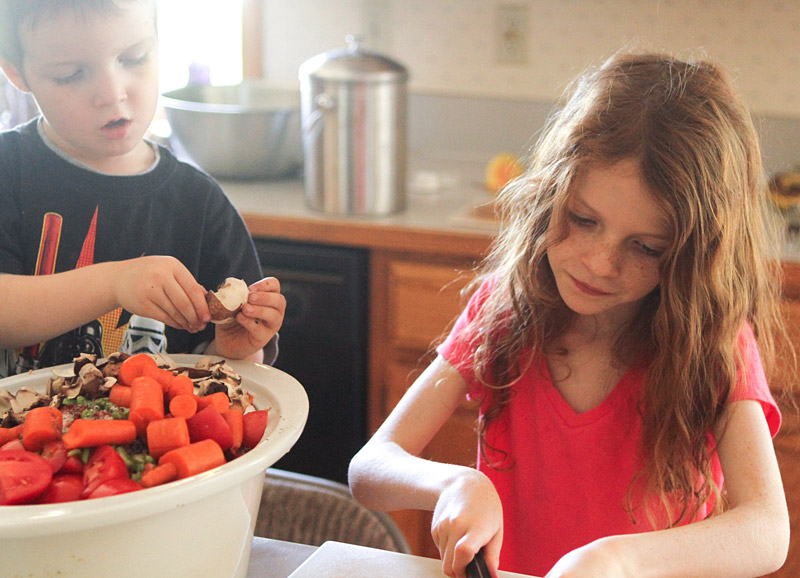
Connect kids to the food. Plant a garden. Go pick your fruit in a field or orchard. Bring your children to the grocery store and have them help you pick the biggest head of kale or decide whether to get big or baby carrots. Let them count out the sweet potatoes. And of course, if you can brave them in the kitchen, do it! If you’re looking for more guidance and structure in having kids in the kitchen, we took a fun online course that teaches kids step-by-step knife skills, measuring skills, etc. for all different age levels.
Remember that food preferences are totally normal! You’re not a worse parent because your child is particular. Continue to offer a variety of healthy foods with love, and everyone wins.
Special Challenges when Transitioning to Plant-Based
It can be very intimidating to consider removing many (all?) foods your kids like from the menu: cheese, chicken, their favorite spaghetti sauce, processed snacks, pepperoni pizza, etc. That’s a big deal!
The great news is that kids are much more adaptable than we give them credit for. Their palates can change pretty quickly given the right environment.
When I switched my diet (as an adult who was fully on board with the health benefits), I disliked all vegetables but two: raw baby carrots and corn on the cob. I gave myself space to eat lots of food I already loved that were plant-based, and time to try new things. That meant oatmeal for breakfast (Related: Serve Oatmeal for Breakfast if at all Possible) and some variation of black beans daily. I found that removing the junk food from my diet did something pretty wonderful: The flavors of whole foods started to come alive. Fruit was sweeter. Broccoli wasn’t bitter anymore. As I tried new recipes that sounded good, I naturally expanded the number of foods I enjoyed. Within six months, there was hardly a vegetable I didn’t like!
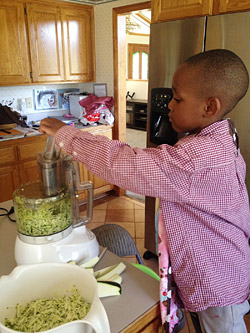
Shredded zucchini with a guest
Although our children have always eaten plant-based, we have hosted many children in our home through the Safe Families for Children program and we’ve always been able to find plant-based food these kids liked to feed them at first as they settle in, and we’ve expanded from there so that within a week or so, they are munching on fresh fruit and veggies between meals, and sitting down to meals they would had turned their noses up to when they first arrived.
These kids do have the benefit of positive peer pressure as they watch my other kids chow on what I served, so be patient with how the process unfolds at your house.
Some suggestions to start: black beans (of course!) and rice, black bean soup, spaghetti sauce and pasta, refried bean burritos, and tomato bisque. For other meals: nut butter with whole grain bread, vegan whole grain waffles, fruit smoothies and muffins.
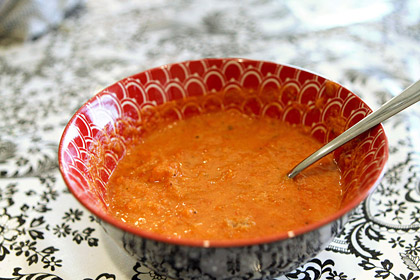
Vegan Tomato Bisque
If something you like can be easily adapted to be plant-based (like simply leaving the cheese off), that’s a good place to start. If you love chili, it’s easy to find a new and delicious plant-based recipe. But, for older kids and adults, I recommend steering clear of “substitutes” like vegan mac & cheeze at first (note the ominous “z” in cheeze). Stick with common ground that doesn’t have to be the same as before in order to be appreciated. Later, after palates have changed, it might be fun to experiment with adapting old favorites to be plant-based.
Have empathy when it comes to your choosy family members as you make different food for them. Change is hard for all of us!
If you are ready to start shifting your family’s diet to include more whole plant foods, you’re in the right place. Rather than tell you which step you should take first, I’m going to lay out ten possible steps and encourage you to start with one that feels both doable and impactful.
After all, if you only rarely drink soda, giving it up would be pretty easy, but it also wouldn’t improve your diet much!
When you’ve got your stride a bit with one step, pick another one from the list and keep up your momentum. Change is hard, but this change is good.
Tackle Breakfast
We are priming our taste buds for the rest of the day when we eat breakfast. A great breakfast will mean you don’t have to think about food again until lunchtime, and making it a deliberate healthy choice will build momentum.
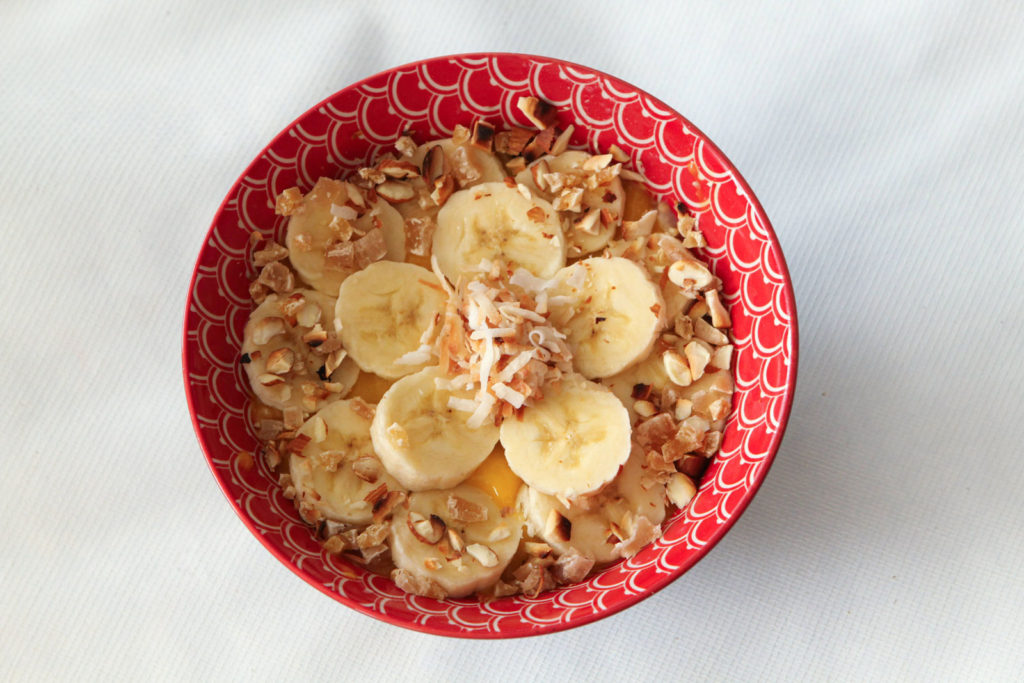
Here’s why I recommend oatmeal if at all possible, but you can also grab some fresh fruit and toast with avocado or nut butter on it. Keep it simple, but for sure swap out the cold cereal*, toaster pastries or bacon. Ack, sorry for mentioning bacon. You won’t miss it forever, promise!
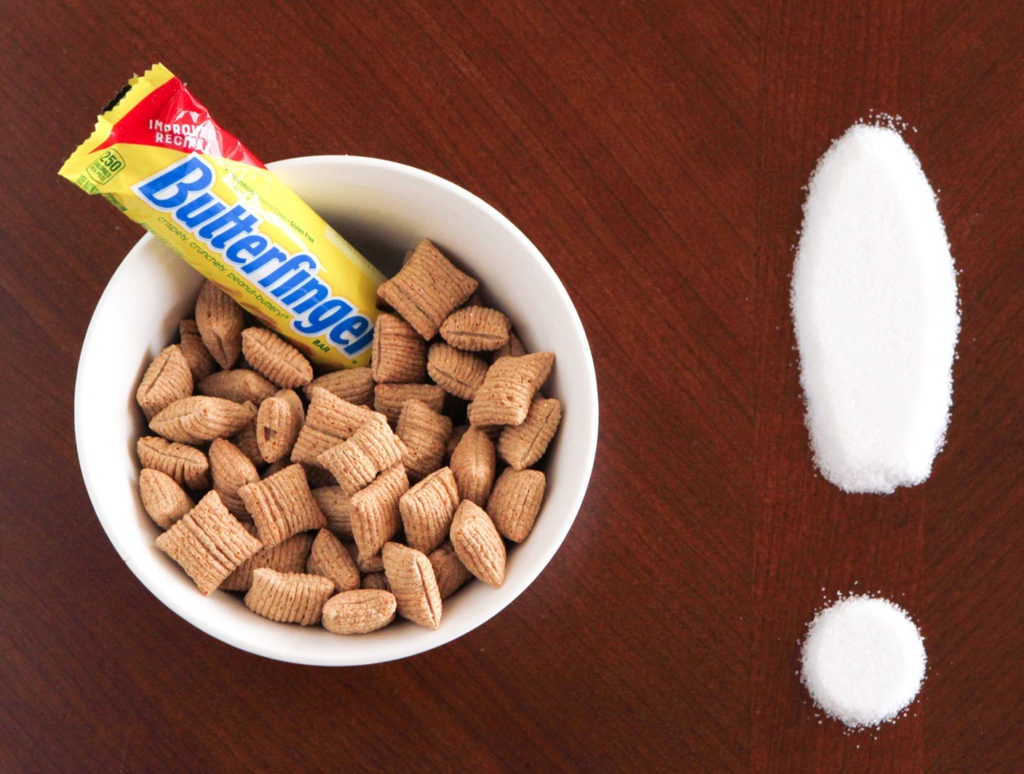
*Eating a good-sized bowl of “healthy” cold cereal meant my kids were getting as much sugar for breakfast as a butterfinger candy bar has, and they were still hungry! So, I had to break up with cereal from a box.
One whole food plant-based dinner this week, two next week.
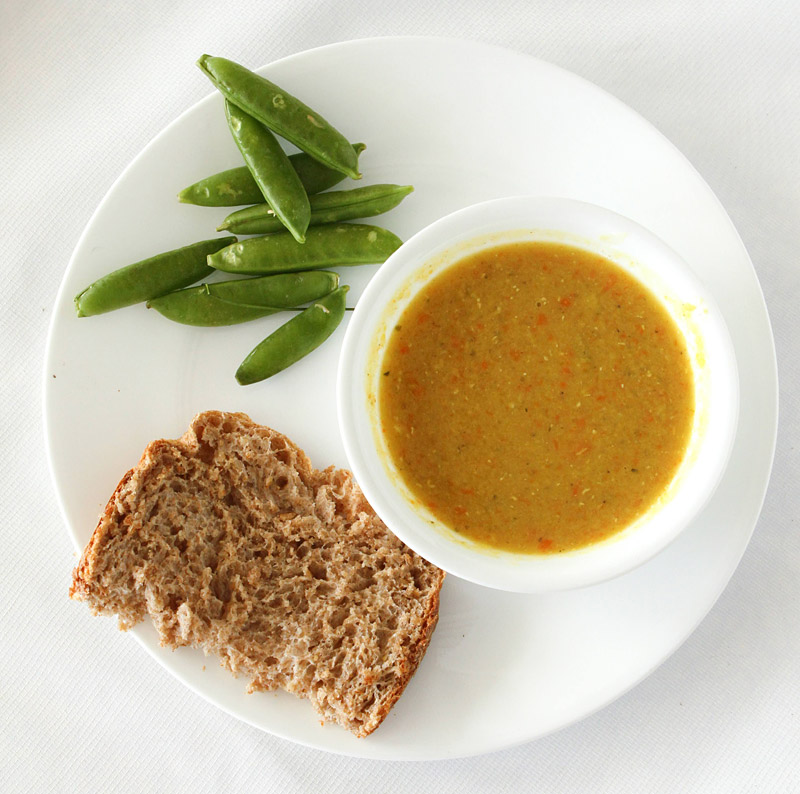
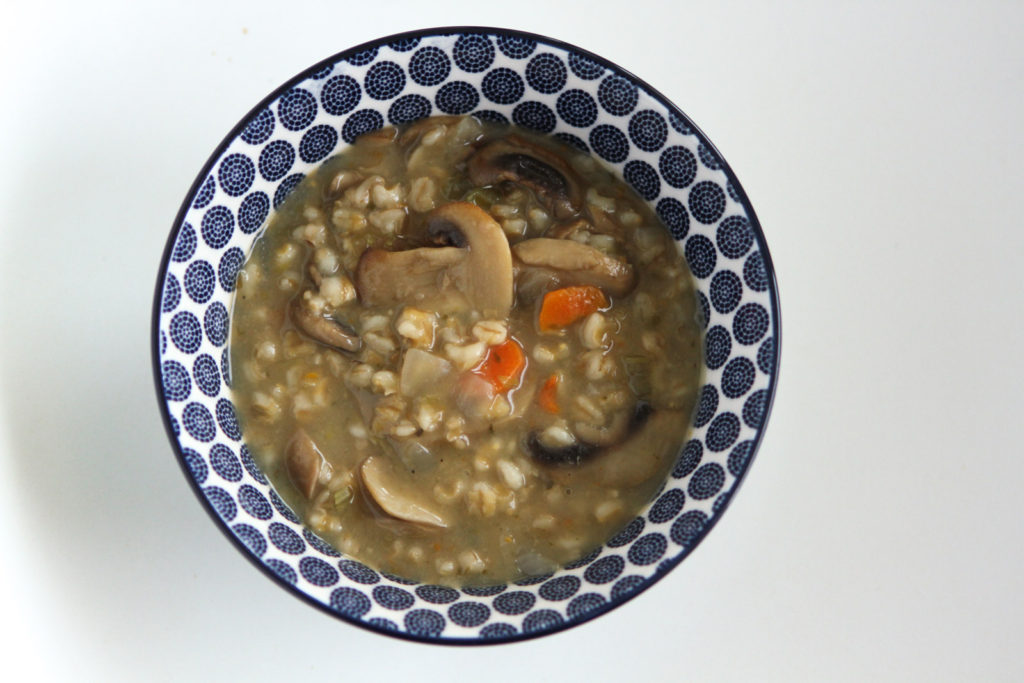
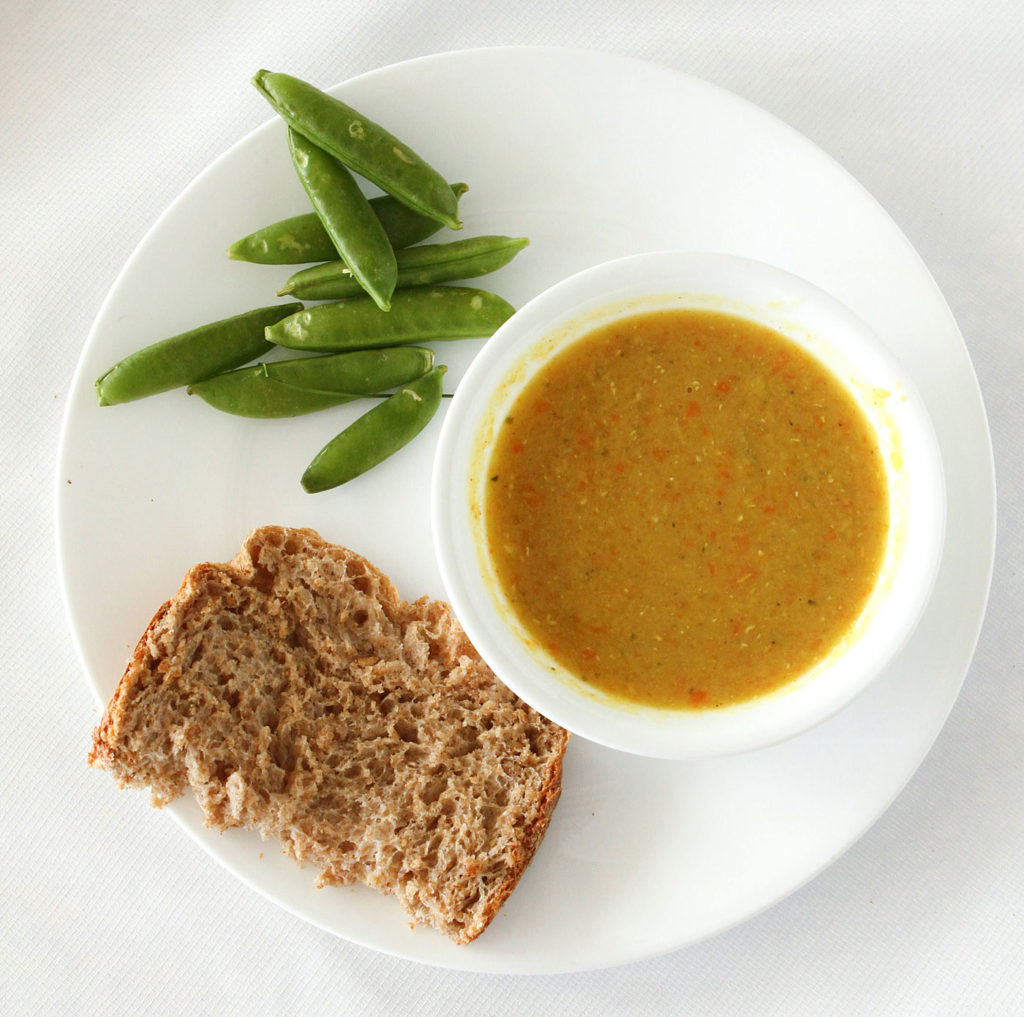
There is a fun trend for “Meatless Mondays,” but we don’t want to stop there. So often I see the meatless dish being full of cheese! Or I see that people feel they’re practically vegetarian now they’ve had a meat-free meal. That’s not doing your health any favors. Have a legitimate, whole food plant-based dinner once a week, then add a second dinner next week, and build from there. Here are my easiest, yummy soups to give you some ideas.
Tip: Remember to eat plenty! You can eat a lovely large amount of whole plant foods because they tend to be high in fiber and low in calories.
Get rid of one dairy item, then another
Cheese is harder for some people to give up than smoking. Maybe start with yogurt? Or stop drinking cow’s milk by the glass? Or give up string cheese or sprinkling cheese on dinner by default?
There are absolutely substitutes for dairy that are vegan, but I usually don’t recommend trying to use them right away. If you choose a vegan mozzarella “cheez” and compare it to a dairy-based cheese, I’m guessing you’ll be disappointed. There are so many delicious plant-based foods that don’t try to masquerade as meat and dairy. Start with those and if you circle back to a vegan sour cream, yogurt, or even “cheeze” later, you’ll be more receptive and enjoy them more.
I do recommend trying some plant-based milk. A good starting point is unsweetened soymilk. It can be used just like dairy milk in baking or splashed into oatmeal or muesli.
Meatless before dinner
There’s a group of people who eat “vegan before 6,” meaning they avoid animal products before dinner. One approach is simply to ditch meat for breakfast and lunch. No more lunch meat or bacon! Adjust to that, find a new groove, then move on to your next step.
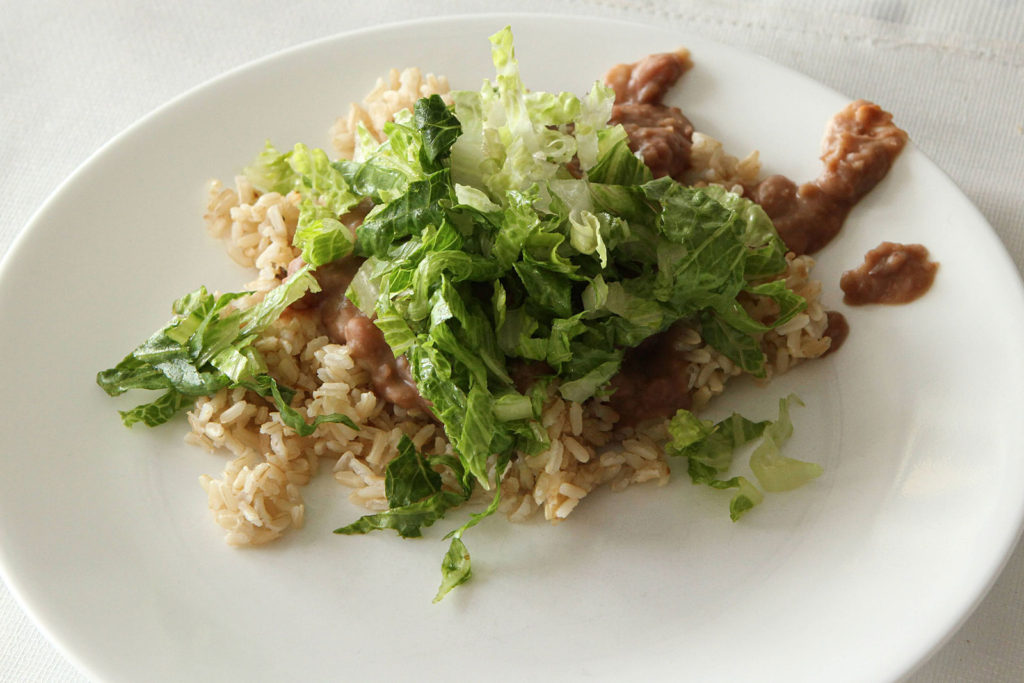
Eat a baked sweet potato for lunch with black beans and salsa or a squeeze of lime. Have a veggie sandwich with hummus. Wrap up refried beans and shredded lettuce into a simple burrito. Go for tofu scramble instead of egg scramble for breakfast. Eat crackers with your tomato soup instead of grilled cheese. With a little creativity, you can find alternatives to what you’re currently eating.
Ditch the fast food
Your plant-based options are going to be limited at fast food restaurants.
Consider why you are turning to fast food in the first place. Are you wanting to feed your family without fussing with dishes? Are you grabbing dinner while running between activities? If you can identify the problem that fast food is currently solving for you, I’ll bet you can solve that problem in a different way.
It may come down to: using paper plates once a week, using the crockpot, packing “lunch for dinner” on that night you are going between activities, or it may be a different solution entirely.
In case it helps, our go-to when we want dinner in a hurry and don’t want to make it are vegetable fajita bowls at Chipotle. We load them with black beans, vegetables, brown rice, pico de gallo, lettuce and guacamole. But it’s at least a 15 minute drive from our house so it’s usually easier to just pull together a lazy plant-based pantry meal.
Ditch processed food
As a general rule, if it has a barcode and an ingredients list, don’t buy it. That’s the end goal, and to get there, you can swap one item at a time. Buy grapes and carrots for snacks instead of fruit-by-the-foot and graham crackers. Buy a whole grain pasta and a tomato-based sauce with real ingredients and ditch the blue box and powdered cheese packet.
Before you toss something in your grocery cart out of habit, pause. Commit to finding a new normal without it.
Get rid of soda
This one is simple to type and more difficult to do. We love Spindrifts on crushed ice. They have a squeeze of real fruit juice, but no sugar or fake sugar, so they don’t hold our taste buds hostage.
Stay the course and pay attention to why you’re reaching for soda in the first place. Is it stress? Just habit? Acknowledge the stress and cope with it in a healthier way. Replace the habit with something that serves you better.
Plan your sugar
Of course ditching sugar in your diet completely would be a home run for health, but for most of us that’s not sustainable. Instead, can I recommend planning your sugar? Decide in advance what treat you’re going to enjoy. And, then thoroughly enjoy it! Otherwise, automatically decline offered sugar.
Here’s an example: I plan on going out as a family to get a donut on Saturday morning. Yum! I’ll enjoy both the anticipation and the experience. And when someone brings donuts (or cupcakes, or cookies, or whatever) to Book Group on Thursday evening, I simply pass them by and grab some of the cut up fruit instead.
Planning your sugar is a deceptively powerful change because it means your self-control muscle gets a break. You aren’t looking at those cupcakes and cookies and wrestling with yourself. You’re just acknowledging there’s always an endless supply of treats in the world, but you’ve already decided which you’ll enjoy that day or week.
I pass up cigarettes without thinking about it every time I go to the drugstore, because I’m not a smoker. I’m also not a random sugar eater.
Next Book Group I may plan on eating a treat and that’s cool, too. But I’m not making those decisions in the moment when presented with gooey chocolate. I’m also not reaching for cookies at 11pm because I’m feeling restless, which I otherwise might be inclined to do. Ahem.
This particular gooey chocolate is a whole food plant-based treat, so that’s a bonus!
Leafy greens every day
There are so many ways to get some greens in your day, and just this one goal will have ripple effects in other areas of your diet. You might start throwing kale or spinach in your breakfast scramble, adding a green smoothie to your breakfast, stuffing shredded romaine or spinach in your lunchtime wrap or putting chopped kale or spinach in your dinnertime soup. Make your burrito into a salad instead by dumping all the filling onto a pile of crisp greens.
Look at your meal plan for the week (or for the next day if you tend to wing it) and see where you could get some greens in. I recommend starting with baby spinach (all washed in a bag or tub) because it’s convenient and it inconspicuous. But curly kale or romaine are both solid choices as well.
Only fruits and vegetables between meals
Snacks often get overlooked when we plan meals, but they count for a lot! In fact, two thirds of Americans are eating at least two snacks a day. We average 24% of our calories from snacks, and what we eat at snack time influences our appetite and taste-preferences when it comes to meals.
So often our kids turn up their noses at what’s for dinner because they’re not actually hungry! They whine before dinner so we hand them something to tide them over, which then prevents them from enjoying what we serve them.
What if we allow for as much snacking as we want, but limit it to fruits and vegetables? No, don’t dunk them in ranch dressing. Just fruits and vegetables. How would our appetite for meals be affected?
Currently just 1 in 10 Americans eats the recommended amount of fruits and vegetables each day. You are about to enter into a very elite group!
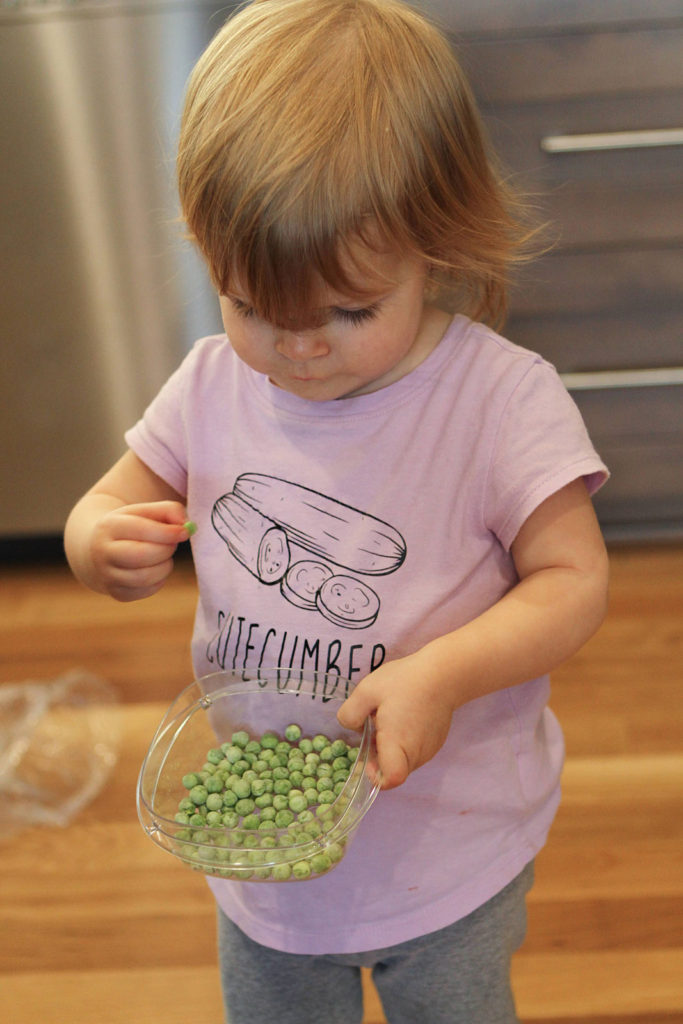
We love munching on snap peas, cucumbers, frozen peas, frozen edamame, carrots, celery, bell peppers, romaine lettuce, sweet mini peppers, watermelon, apples, oranges, bananas, pears, grapes, canned pineapple, and so much more!
(I do personally limit my kids to one fruit as a snack per day, unless it’s apple or peach season, simply because our grocery budget would be out of hand if they were given free rein. I also have them start with a vegetable snack. )
Ok, enough yacking. Time to get cracking! Pick an area of focus get started and remember any progress counts! Progress, not perfection, is the goal.
I’d love to hear how you’re doing with changing your family’s diet. Please drop a comment, so I can cheer you on.
I have five children and the pre-dinner hour can be chaotic. People are hungry, we’re hustling to get the house picked up before Dad makes his much-anticipated appearance, I’ve got multiple pans in the fire (sometimes literally!) and everyone’s nerves seem a bit raw.
But most nights there’s a glittering reward coming. The reason why I bother cooking and being in the thick of things in the kitchen with my kids is those upcoming golden moments sitting around the table with them. There’s good food, good conversation, and good vibrations. It’s pleasant.
Or rather, it can be pleasant. Ahem. But if there’s grumbling, pouting, wandering off, interrupting, falling out of one’s chair, spills and constant hopping up, it’s less peaceful than it could be and more painful than it needs to be.
I get a kick out of this poem:
A child should always say what’s true
And speak when he is spoken to,
And behave mannerly at table;
At least as far as he is able.
Robert Louis Stevenson
We have two kids with ADHD, and our ages span 1-12, so the last line of that poem sure rings true around here. Kids aren’t adults, and their table manners won’t be perfect! But, here are 7 principles I’ve found that help kids behave their best at the table and make the meal more enjoyable for their parents as well.
1. Start the meal on the right foot
Until I started following this guideline, I was hopping up and down constantly during a meal. Someone always seemed to need something the instant I sat down, and I spent dinnertime more like a waiter than a participant in the meal.
Now? I take a minute to ask if anyone needs anything before I sit down. All drinks, silverware, bowls of soup are distributed before I take my seat. And then? I don’t get out of my seat until I offer “seconds” to the family*.
If someone forgot to grab something, wants a different sized spoon, or wolfs down their burrito before I finish chewing my second bite, they wait until I call for seconds.
Even my toddlers adjust to this and learn to wait, though I have them sit next to me at the table, so I can reach over to help them with some things without getting up.
Waiting for seconds also lets the foods settle in stomachs a bit, and register as “full” to our brains, which helps us all eat an appropriate amount.
*I do get up for actual emergencies, which do sometimes happen with a bunch of kids…
A similar principle applies to my kids taking their seats: They know they need to wash their hands and address any bathroom needs before joining us at the table.
Level Up: Teach your kids to wait to eat until everyone is seated. That’s good etiquette, and eating at the same time also allows them to see how you eat and mirror that.
Pro Tip: I’ll often set a timer halfway through the meal so I don’t forget to offer seconds, and the kids can relax about the possibility I might forget. (I may have forgotten a few times.)
Eating Out: My kids are far more patient in restaurants now, because they are used to having time just sitting patiently at the table rather than having their needs instantly met.
2. Nobody is allowed to criticize the food.
From the very beginning, I’ve taught my kids to say something positive or say nothing at all. If they are asked how they like the food, they know they can say “it’s not my favorite.”
I do value thoughtful feedback, and I’ll sometimes ask for further details, but I have never allowed them to say “yuck” or “gross” or “I don’t like that” to anything they are served.
This one practice has paid so many dividends!
It’s discouraging to someone (usually me!) who’s really tried to make something delicious, putting time and money and effort into it, to be met with careless disparaging remarks. Of course I can tell the foods my kids aren’t big fans of. I don’t need to hear griping about it.
It allows my kids to reserve judgement about something and to change their minds with dignity. They can think they won’t like something, try it, and find that they do without losing face because they proclaimed it “disgusting” on sight. It helps them keep an open mind!
We often host extra kids in our home through the Safe Families for Children program, so we have experience with helping kids quickly learn how to contribute to a great meal experience. I promise they can learn this!
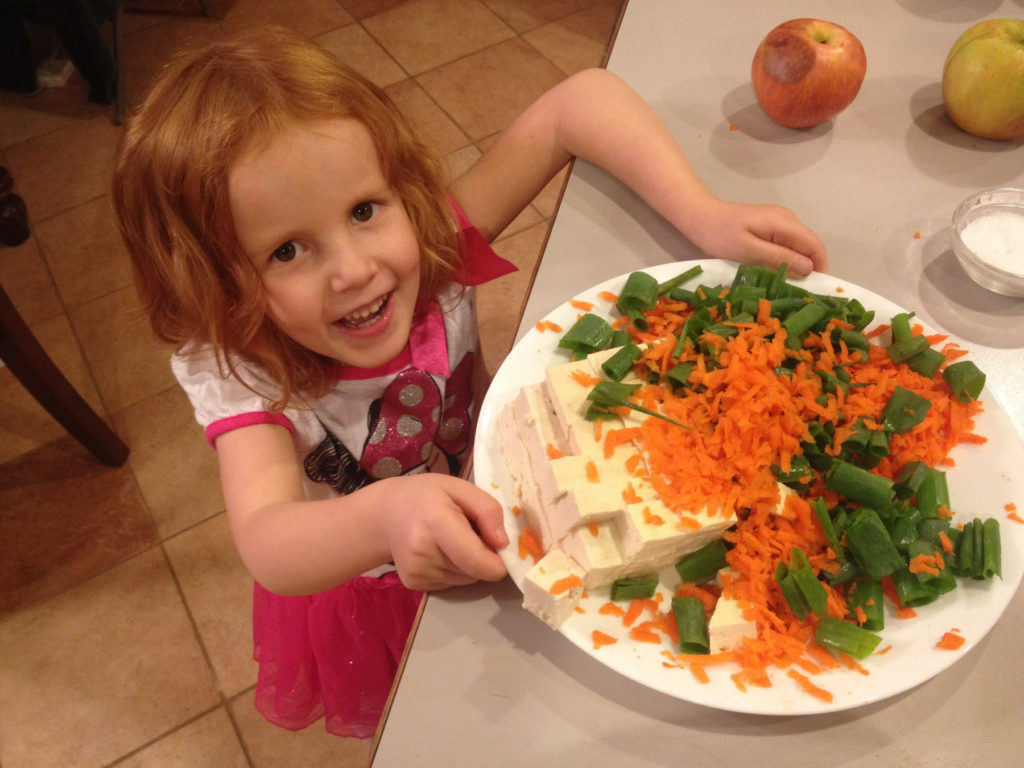
My daughter thought the plate of ingredients for that night’s stir fry were her dinner, and she was still polite!
Pro Tip: I highly recommend pro-actively teaching your kids to say “it’s not my favorite” at a neutral time, rather than try to just correct them into learning it. You don’t want this to be a battleground. It’s simply a life skill to be gracious when someone serves you food.
You can pretend to serve each other truly gross food and respond politely anyway. Just “thank you” with a smile, or you can challenge yourself to find something positive to save about almost anything they come up with! Keep it light but do be consistent once you’ve taught it, so they get in a new habit.
Eating Out: Naturally, this habit applies outside the home as well. I’m always embarrassed for kids when I see them responding at restaurants and friends’ houses in a hasty, impolite way. Kids often say the first thing that pops into their head, but if they are explicitly taught, and gently reminded, they’ll know how to be more agreeable.
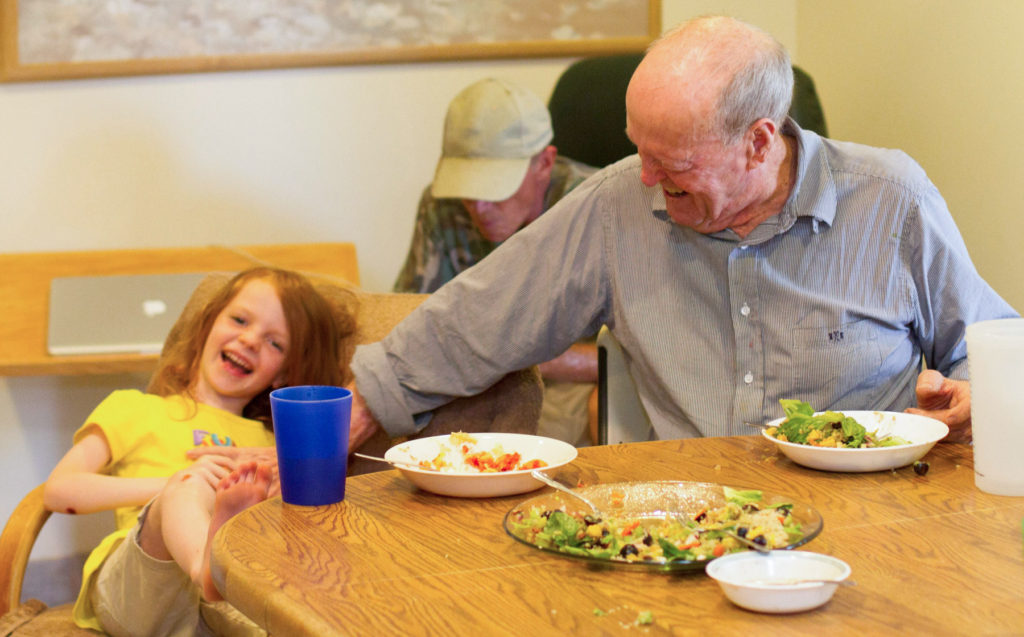
Ok, ok, her feet are on the table, but she was polite about the food, and Grandpa appreciated that.
3. Requests, not Demands
She’s signing “please.”
We teach our children to ask for what they want, rather than just append “please” onto a demand.
“More soup, please!” is a demand.
“May I please have more soup?” or “Would you please pass the soup?” are requests.
It seems like a subtle difference, but it makes a significant difference in the overall tone of dinnertime exchanges.
4. Meals can have a minimum length of time
I have some kids who would be inclined to say “I’m not hungry” or “I’m not eating” if it’s a new food, or one that’s not their favorite. Or on the flip side, some kids would bolt down their dinner without tasting it, and then tear off to do something else, or just plain wander off and claim hunger shortly after the meal is over.
If instead they know they are committed to the time sitting at the table, it’s amazing what foods they’ll try and what they’ll say in conversation.
Our children with ADHD especially benefit from these tips:
Set a timer at the very low end (maybe 7 minutes if that’s all they’re used to) and stretch it out slowly from there, adding a minute or two per meal.
Wiggly kids may need to push their plate backs when they’re through eating so they don’t flip their silverware onto the floor or knock over their glass with their elbow, but with practice they’ll get better about staying and engaging with the family for extended periods of time.
Send the wiggly kid to do all the errands at “seconds” time (and occasionally at other times if they’re looking especially restless). It gives them a positive, helpful reason to streak out of their chair, which is what they are burning to do anyway.
Reading a great book aloud as a family can hold the attention of a normally fidgety kid much longer, allowing everybody to enjoy the experience more. Pippi Longstocking is a great, silly way to begin reading aloud if this is new for you.
Eating Out: A child who is used to waiting at the table at home is better equipped to handle the wait times at restaurants.
Try playing an observation game when you go out. Have everyone else close their eyes and ask them “noticing” questions about their surroundings, such as “Did anyone notice how many chairs are at the table next to us?” or “Did anyone notice the wallpaper? Can you describe it?” They can have you take a turn as well. It can help kids feel interested and curious (and sometimes competitive) rather than bored and restless. Bonus: it teaches situational awareness.
5. Meals can have a maximum length of time
Here’s something to try with kids who tend to dawdle, so they learn to pick up the pace and you are spared the complaining at the end of the meal when they are caught off guard. Simply set a timer that’s a little bit of a stretch for them but still allows them time to eat enough, then subtract a minute or so every few days until you’re down to at a time you can both work with. For us that’s 30 minutes for breakfast or lunch, and 45 minutes for dinner.
The Slowey Joey will be reminded that the meal is moving along when you offer seconds, and sometimes you may want to give them a “five minutes left, finish your bites!” courtesy reminder as well.
Often a child won’t finish their food because they are busy talking during the meal. There are alternatives! These help with any chatty kid, including those who tend to talk with their mouth full.
Here again, reading aloud a great book a habit at the table is very effective, so the child’s only job is to listen and eat. This also gives the whole family something to talk about towards the end of the meal and a great shared experience to build upon.
Find another way to rotate who is speaking, so that kid’s mouth gets a break to put food into it. Perhaps go around the table answering a certain question, or sharing “high and low” parts of your day, so everyone gets a turn.
Start the meal with 5 minutes of silence. Sometimes with the flurry of activity before a meal, a kid may need time to settle into the task at hand without distraction.
6. Nothing but food at the table
No phones. No books (unless it’s a family read-aloud). No toys. Just the food and the faces of the people you love.
7. Make it wonderful
Do create systems and teach your children what you expect for mealtime behavior, but don’t be the etiquette police in the middle of the meal. The goal is for everyone to enjoy themselves. Here are some ways we facilitate that:
We try to include at least one food in the meal that is liked by all. Even if it’s just tucking a few apple slices onto the plate next to the new mushroom pasta dish, having a friendly familiar food does wonders for choosy kids as they warm up to the newcomer.
We try to use nonverbal reminders at the table. All I need to do is raise my eyebrows and make a silly alarmed face for my son to notice he got carried away with volume or activity level. He can then recover gracefully without a public scolding.
We do fun things periodically. One of my favorites is One Minute Speeches. They involve each person picking (or being assigned a topic), having one minute to prepare, and one minute to stand and deliver a speech. The topic might be “colors” or “trips you’ve taken” or “animals you’d like to see up close.” Almost any topic will yield wonderful results. We offer uproarious applause and specific compliments after each speech.
Bonus Tips
8. Set yourself up for success
Here are a few things you might consider to minimize (extra) mess and disaster at the table:
Buy cups that are less tippy. Shorter, with a nice base, filled with water (not milk or juice), no more than halfway full.
Get easy-to-clean chairs. If you’ve got kids, ditch the fabric chairs or the ones with the little grooves or rungs in the back that catch grime. After years of trying to cope with the ones that matched our dining table, we got smart and got ones like these instead (affiliate link). They’re wipeable and not tippy. We’re all more comfortable now.
9. Teach individual skills as needed
Teach your kids to sit on their bottoms and “belly up” to the table. You can role play this outside of mealtime. Make it fun and show both the wrong way and the right way.
Kids who know how to sit properly don’t fall out of their chairs (nearly as often), and don’t spill all down the front of themselves (again, as often.). We’ll also remind them sometimes to “mind the gap” because if they are sitting back from the table an awful lot of spillage can happen between the dish and the mouth!
Work with your kids on not interrupting. Again, do this at a neutral time not in the moment.
Talk about how nice it feels to be able to finish a thought completely, and do a silly role play where you interrupt each other like crazy.
Teach them how to get your attention instead, perhaps by placing a hand on your arm or by raising their hand at the table.
When it’s not in the middle of a meal, we have our kids run a number – their age in years – laps around a loop in our house (or do pushups or jumping jacks) when they interrupt. Most often they are interrupting because they are so excited to talk, and they learn that it takes much longer to get a chance to speak if they interrupt.
Consider having some “adult conversation” dinners, where the adults are talking and kids wait to speak until they’re directly asked a question. This is an old-fashioned idea, but we’ve found it’s a great opportunity for kids to learn some restraint and respect, as well as be able to hear the give and take of a mature conversation.
Lauren is signing “please,”before she signs “more.”
Teach your babies (at least) simple signs for the dinner table. It’s very easy to teach them to say “please” and it’s priceless not to be screamed at every time they would like something! I recommend “please,” “eat,” “thank you,” and “more” as a starting point. This will help bridge the frustrating gap between when they have very clear desires in mind and when they are able to articulate them so as to be understood.
10. Everybody Cleans
I usually don’t want more than a child or two in the kitchen with me preparing dinner, because it gets too crazy. But we do carry all those good feelings from the table over to cleaning up as a team. It’s a way for the rest of the family to thank those who made the meal, and we enjoy it.
We throw on a fifteen minute timer, some fun music, and we all jump in with our assigned jobs.
Teach your children how to help! They’ll feel good about contributing, and you’ll feel good about the state of your kitchen. Right now our table jobs are:
12 yo clears and wipes counters, puts away leftovers
9 yo does all the dishes
7 yo clears and wipes the table and chairs
4 yo picks up food that fell under the table
1 yo dances adorably to the music. Music is key!
Pro Tip: I find sticking with the same task for at least a year makes them an expert and eliminates the confusion and hassle of rotating.
Eating Out: Our kids are extra grateful to have someone else do the dishes when we eat at a restaurant, and they’re able and (usually) willing to help clean when we are guests in others’ houses.
Please share what works for your family in the comments.



 Anne Bean
Feed Them Plants
Anne Bean
Feed Them Plants
 You can find loads of lists online with “quick tips” to get kids to eat more vegetables, but what I’d like to do is walk beside you as you change your family’s food culture.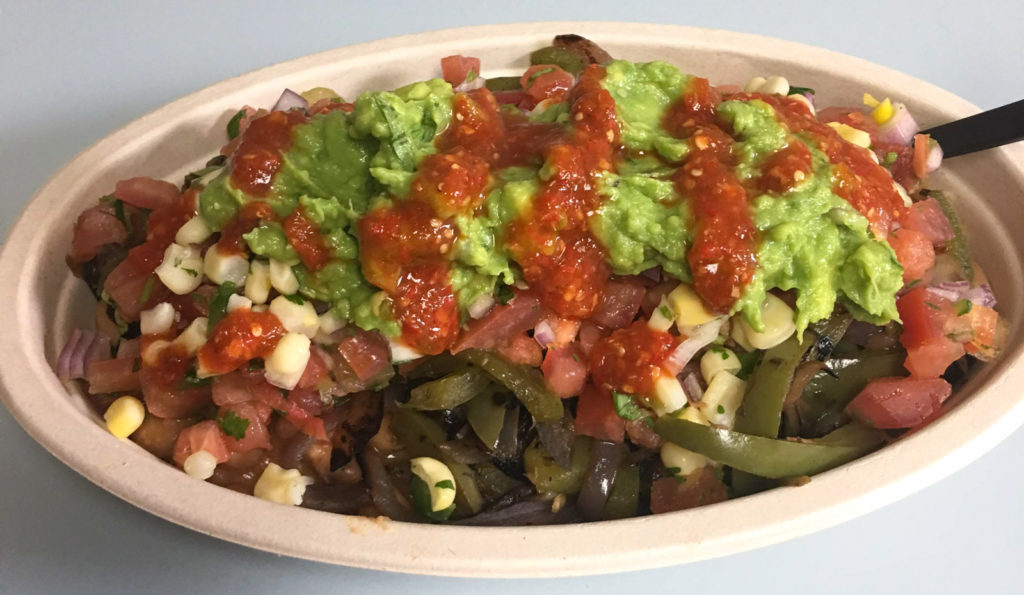
 Unfortunately, there is a lot of confusion in the popular press about what constitutes a healthy diet. So many trendy diets come and go (Atkins became paleo, which became keto! Macros! Whole 30! “Eating Clean” and countless more). Everybody loves controversy, so we click on articles that imply red meat is healthy after all, that coconut oil is the new miracle food, and that eggs aren’t as bad as we thought.


 But here’s the thing: broccoli doesn’t have a very big marketing budget. Blueberries or lentils aren’t going to buy their way on to our instagram feed very often. When food is processed, it’s more expensive to buy and cheaper to produce, which leaves enough profit to invest in more flavor engineering and plenty of very targeted marketing.
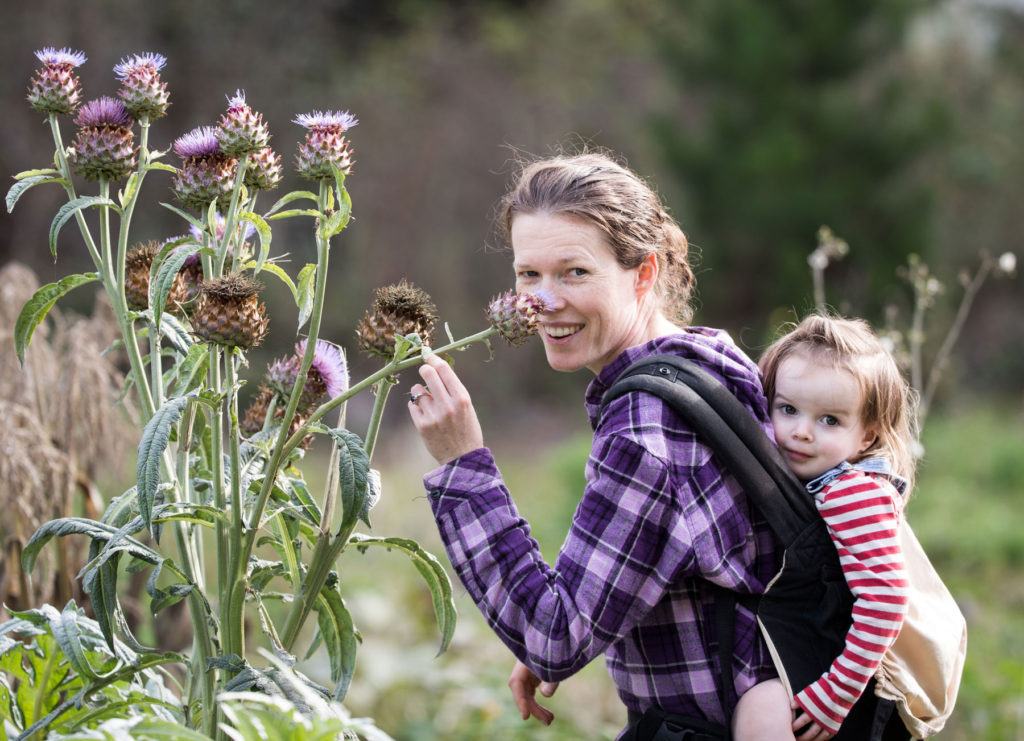
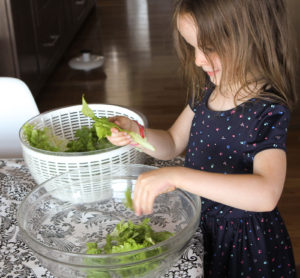
 My husband is a family physician and often has parents come in concerned about their children’s weight. These are great parents who are anxious for their children to have a great start in life. My husband often gently asks them about their own weight and habits with food as a starting point to the conversation, knowing that where the parent isn’t willing to go first, their children have little opportunity to follow.

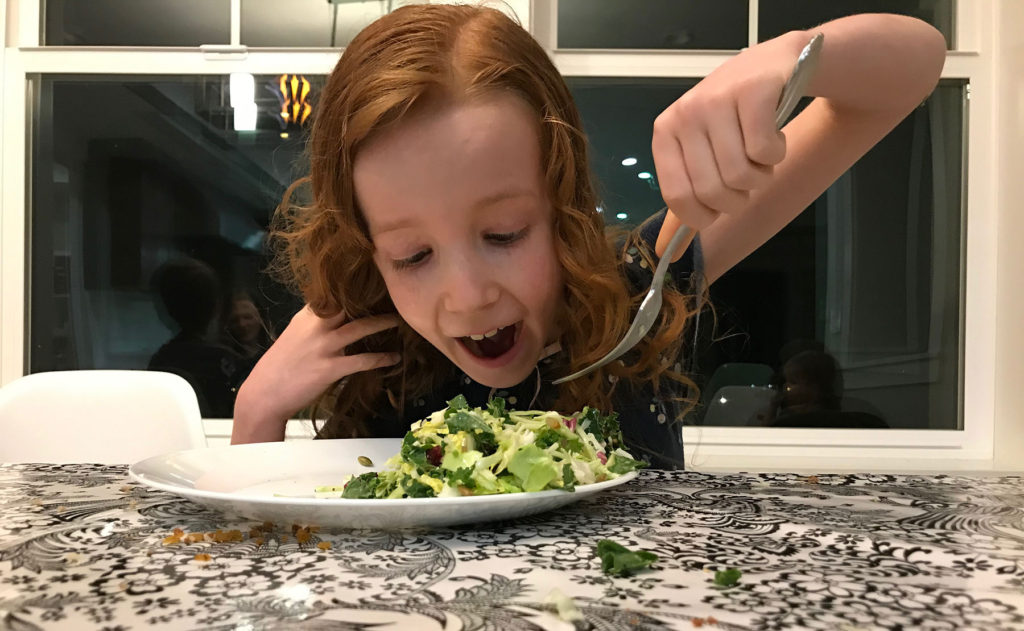
 Go ahead and consider the approaches and decide which one is the best fit for your personality and circumstance.